Insulation Failure “Visualization” for More Efficient Battery Hipot Testing
Introduction
In many production facilities, dielectric withstand voltage testing (hipot testing) is performed to confirm that products can safely withstand high voltage and to reduce the risk of electric shock. However, when a unit fails the test, operators often struggle to determine what actually happened—was it a sudden insulation breakdown, or a gradual increase in leakage current?
Conventional hipot testers typically provide only a pass/fail judgment based on a current threshold. To investigate the root cause, engineers must set up additional instruments such as an oscilloscope, high-voltage probes, and current probes. This adds cost and setup time—and in cases where the failure is intermittent and the unit passes on retest, teams may end up with no conclusive evidence at all.
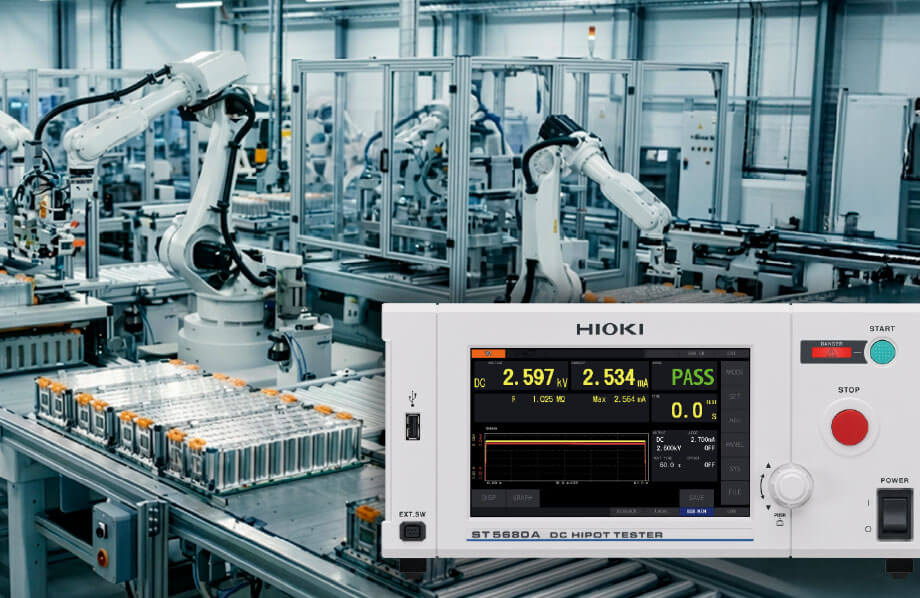
The ST5680A DC Hipot Tester addresses these challenges by integrating waveform capture and display directly into a DC hipot tester. Operators can immediately review voltage and current waveforms just before the test stops—without external equipment—enabling faster, more reliable failure analysis on the production line and in QA. This helps shorten feedback loops to design and manufacturing teams and reduces overall test-related cost.
Background
Production lines for electrical components, batteries, and mobility-related products typically perform hipot testing prior to shipment to verify insulation integrity. Due to manufacturing variation, occasional test failures are inevitable. When they occur, teams typically retest the unit and investigate the cause to prevent recurrence and to provide objective evidence for customer support and complaint handling.
However, conventional testers only evaluate whether the leakage current stays below a preset limit during voltage application. As a result, they cannot distinguish between the two representative failure modes:
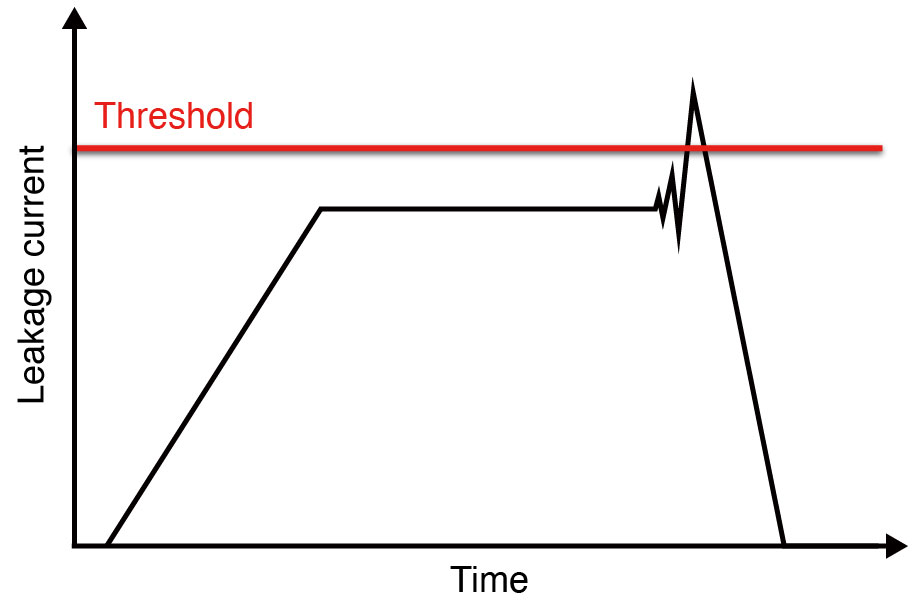
- a sudden insulation breakdown (a sharp current spike), and
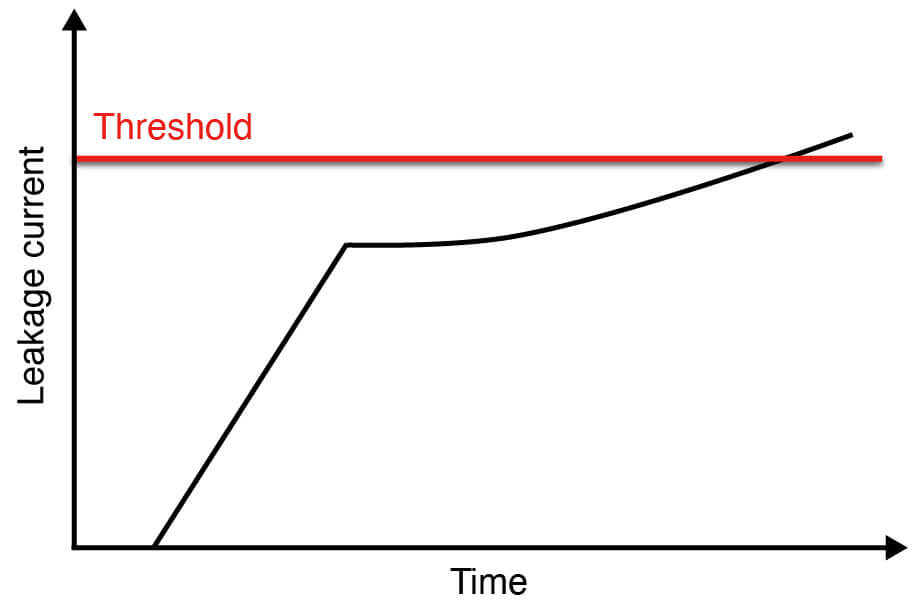
- a gradual increase in leakage current.
In addition, they cannot tell whether a given failed result is actually due to:
- a situation where current is merely flowing near the threshold setting, and the unit is formally judged as a failure even though no catastrophic insulation defect is present.
This lack of visibility into the nature of the failure result makes it harder to pinpoint root causes quickly and to define effective countermeasures or provide convincing explanations to stakeholders.
Why distinguishing the two failure modes matters
Being able to distinguish between abrupt insulation breakdown and gradual leakage growth has a direct impact on what actions engineers should take after a failed hipot test.
If the waveform clearly shows a sudden insulation breakdown, likely causes include localized degradation of the insulation material, contamination or foreign particles introduced during manufacturing, or mechanical damage that reduces withstand voltage in a specific area. In such cases, effective countermeasures typically involve feedback to design and production processes—for example, reviewing material selection and structure, tightening contamination and foreign-matter control, or investigating specific lots and process steps.
In contrast, if the waveform shows leakage current slowly increasing over time, potential causes extend beyond material aging to include changes in environmental conditions such as temperature and humidity. Here, the focus shifts to operational and environmental controls: storage and aging conditions for components and finished products, and management of the test atmosphere (temperature and humidity) on the production line.
There are also cases where current flows steadily near the threshold level and the unit is classified as a failed unit, even though no clear breakdown event is observed in the waveform. In such situations, the issue may not lie solely with the DUT, but with the test conditions themselves—including the leakage limit, test duration, and voltage ramp profile. Reviewing the waveform while reassessing acceptable leakage current and test parameters helps prevent excessive false failure judgments.
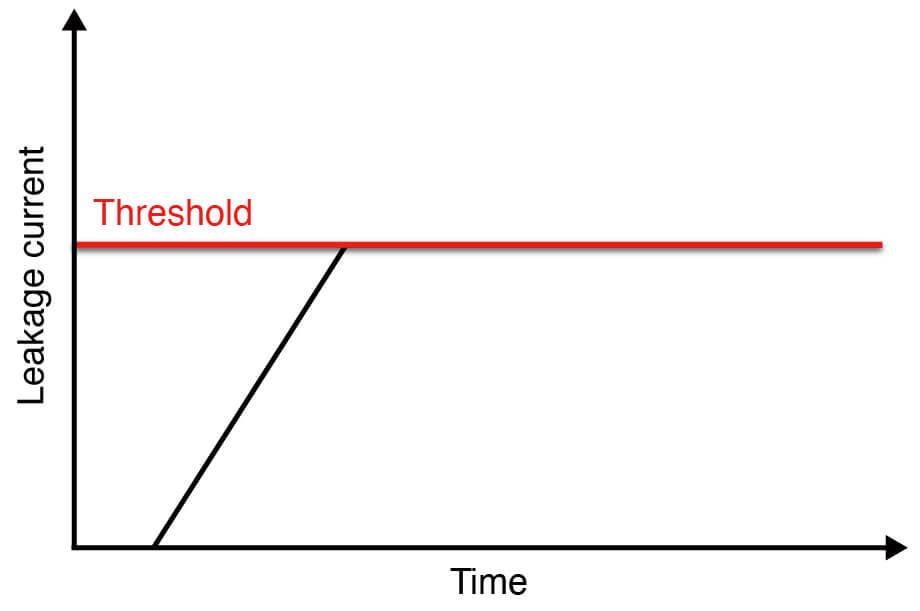
In other words, even when the outcome is the same failed test result, the most appropriate response will differ significantly depending on whether:
- the failure is a sudden breakdown event,
- a progressive leakage trend, or
- a misjudgment driven by threshold and test-condition settings.
By turning insulation behavior into tangible voltage and current waveforms and making the details behind each failure result visible, engineers can:
- perform faster failure segregation on the production line,
- provide more precise, targeted feedback to upstream design and manufacturing teams, and
- present objective, waveform-based evidence in post-shipment complaint handling.
This is why distinguishing between these two major failure modes—and separating them from condition-driven misjudgments—plays such a critical role in making hipot testing and quality assurance more effective.
On-site challenges
- Without waveforms, engineers cannot reliably characterize the nature of insulation failures.
- Preparing external instruments for every failed unit is costly and inefficient.
- Even after external measuring equipment is prepared, the unit may pass on retest—wasting time and delaying effective feedback upstream.
- In post-shipment complaints, there is often no waveform record to demonstrate what the original inspection actually observed.
Solutions
The ST5680A waveform display function records up to 260,000 points of data (approximately 0.5 s at 2 µs sampling) immediately before the test stops. This allows operators to capture the true voltage and current behavior at the moment of failure and clearly distinguish breakdown events from leakage trends—directly on the instrument.
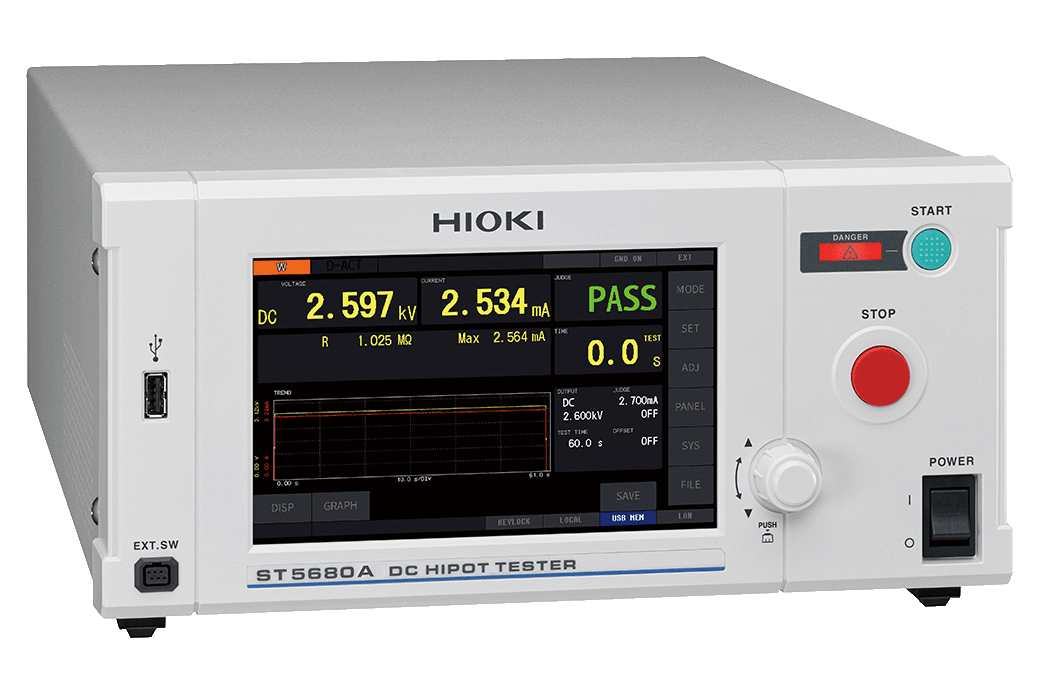 DC HIPOT TESTER ST5680A
Because waveform acquisition and review are built in:
- No oscilloscope is required
- No high-voltage or current probes are required
- Operators can verify what happened immediately, accelerating root-cause investigation and reducing unnecessary retests
For customer complaint response, teams can provide not only the judgment value, but also the actual voltage and current waveforms as objective evidence.
Measurement example
A DC hipot testing of 1000 V was performed on a 10 MΩ dummy resistor with a 0.5 mA leakage limit (Fig. 1). To simulate breakdown, a 1 MΩ resistor was intentionally connected in parallel. The current increased from approximately 0.1 mA (before connection) to 1 mA (after connection), exceeding the limit and resulting in an UPPER FAIL judgment. The waveform clearly shows the abrupt current increase.
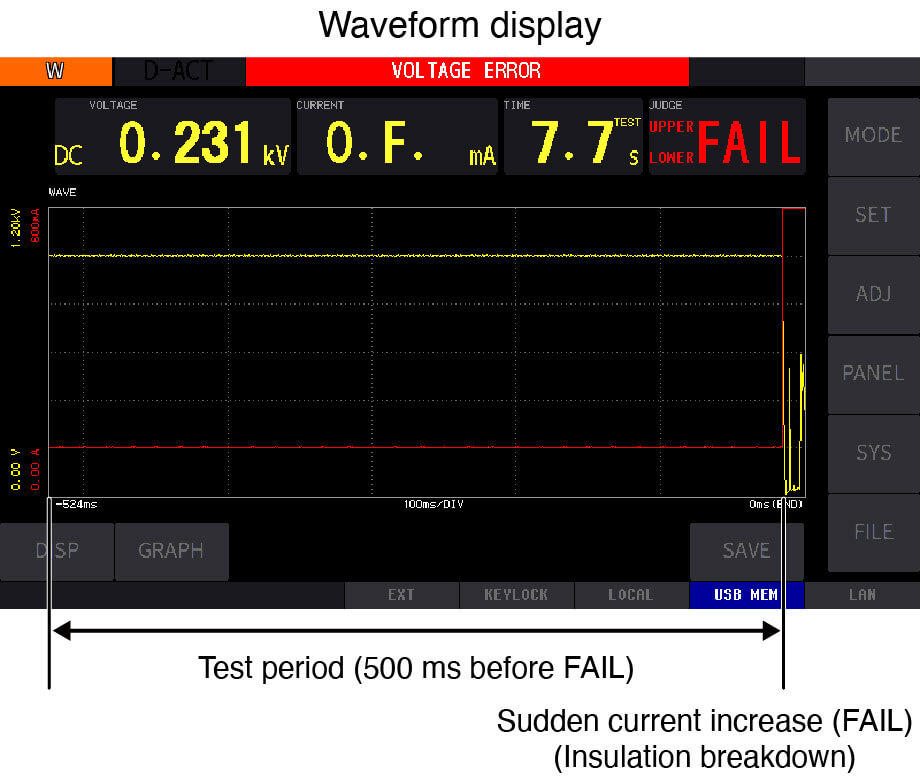 Fig. 1. Trend data simulating insulation breakdown
This example demonstrates how the ST5680A can make failure dynamics visible—insights that are difficult to obtain with conventional “threshold-only” testers—supporting more efficient quality assurance for batteries, components, and production environments (Fig. 2).
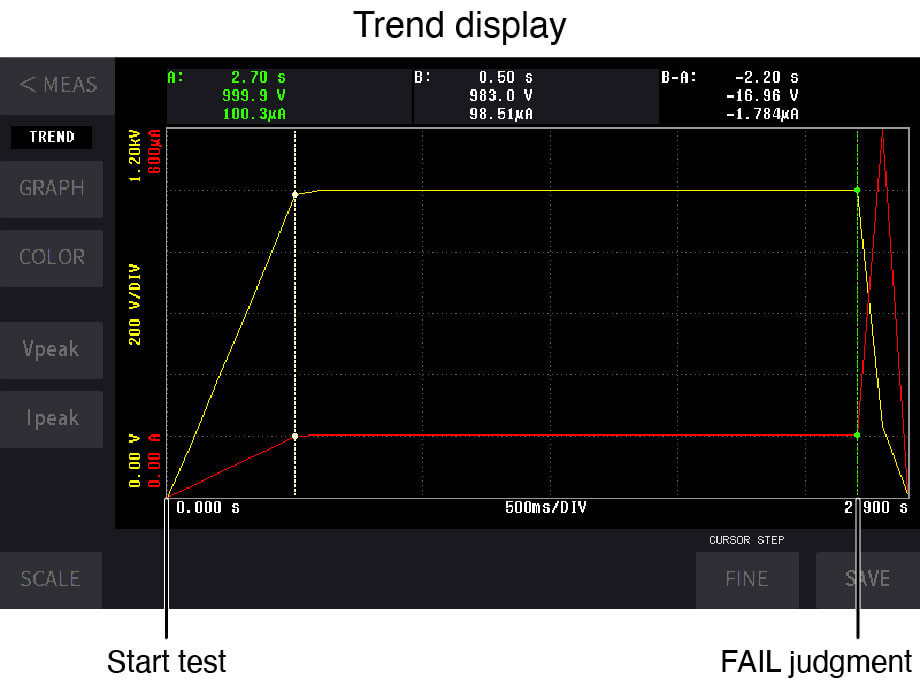 Fig. 2. A magnified view highlights the rapid change in current more clearly
Hioki product configuration
The ST5680A is a standalone DC hipot tester with built-in waveform recording and display. It complies international safety requirements such as CE, UKCA, and CSA, provides high-resolution waveform capture (up to 260,000 points), and enables simple on-screen analysis—improving productivity for both production and QA teams. In high-voltage safety verification—especially in battery and mobility applications—faster, more decisive failure analysis directly contributes to lower cost and higher product reliability.
Summary
By embedding waveform visibility into the hipot workflow, the ST5680A enables:
- Elimination of external measurement equipment
- Shorter failure analysis time
- Actionable data for internal improvement and customer communication
This approach reduces retest-related waste, strengthens confidence in inspection results, and ultimately supports safer, higher-quality electrical products.
For detailed product information, please visit our website.
For a demonstration or consultation on a specific application, please contact us.
We can propose a practical solution that improves QA speed while keeping test costs under control.