Multi-point Temperature Measurement in Battery Pack Development
Why is temperature evaluation so important in battery pack development?
With the widespread adoption of EVs and HEVs, battery packs are now required to achieve higher energy density, greater power output, and enhanced safety simultaneously. Under these conditions, thermal management has become a key factor that directly affects battery performance and reliability.
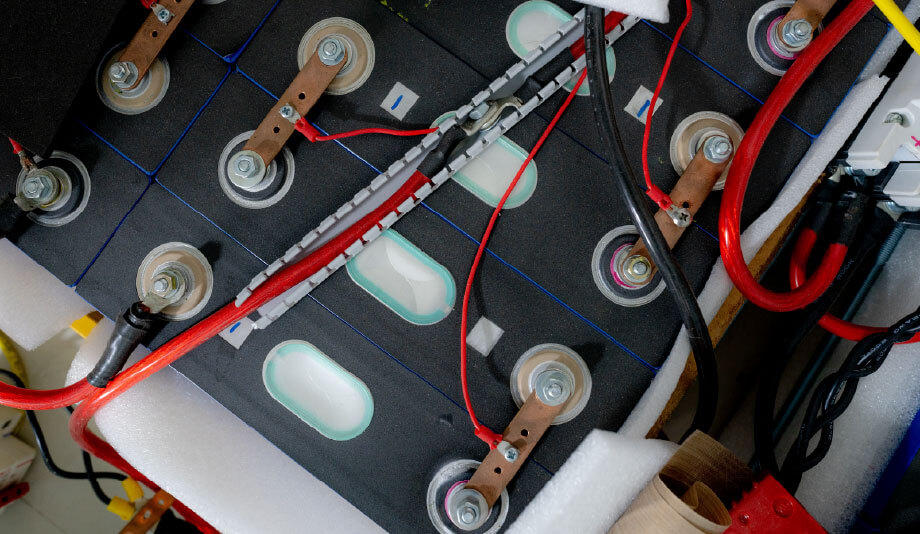
Battery temperature has a significant impact on performance, lifetime, and safety.
For example:
- If the temperature is too low, output and charging performance cannot be fully achieved.
- If the temperature is too high, degradation accelerates, and safety risks increase.
- Temperature non-uniformity within the pack leads to uneven aging among cells.
To address these issues, battery packs are equipped with a BMS (Battery Management System) that controls charging, discharging, and cooling based on temperature data. During the development phase, it is important not only to acquire reference temperature data to verify BMS control and algorithm design, but also to examine temperature differences between cells and the temperature distribution within the pack to confirm that the placement of temperature monitoring points is appropriate.
For this reason, battery pack evaluation should not rely on only a limited number of measurement points. Instead, it is essential to capture temperature at multiple points and visualize the temperature distribution and its changes over time.
Methods for battery pack temperature evaluation
The roles of thermistors and thermocouples
In battery pack temperature evaluation, it is common practice to use both thermistors and thermocouples, depending on the application.
- Thermistors
Thermistors are pre-installed temperature sensors inside the battery pack. Because BMS development requires time, engineers can evaluate thermal behavior using these integrated thermistors before the BMS is finalized, allowing development activities to proceed in parallel. - Thermocouples
Offer high flexibility in installation and are well-suited for understanding the overall temperature distribution of the pack and identifying hot spot trends.
In this way, thermistors are used to verify temperature from the BMS perspective, while thermocouples are used to capture the overall temperature distribution of the pack. By using them appropriately, it is possible to evaluate the battery pack's thermal behavior more comprehensively.
Why does multi-point temperature measurement require so much effort?
The “Hidden Costs” of setup and data analysis
At first glance, measuring the temperature of a battery pack may seem like a simple task. However, engineers in evaluation environments spend much more time not on the measurement itself, but on the preparation before measurement, and the data organization and rework afterward.
Cable routing, noise countermeasures, configuration of scanners and loggers, connection checks, continuity checks, and post-processing to align thermistor and thermocouple data… these tasks accumulate and quietly but steadily eat into the evaluation schedule.
Especially in multi-point measurements, the amount of wiring and configuration work increases with the number of measurement points, and preparation before measurement alone can require significant effort. Even after the measurement is completed, time is still required for data organization and visualization, and the work after measurement is by no means trivial. The accumulation of these tasks becomes a major factor that puts pressure on the overall battery pack evaluation schedule.
A wireless temperature measurement solution that dramatically reduces setup effort
Compact and Portable Data Logger
The distributed modular temperature measurement system, combining HIOKI’s LR8450-01 Wireless Memory HiLogger with the LR8537 (Thermistor Module) and LR8532 (Voltage/Temperature Module), offers a fundamentally different approach to addressing the setup challenges that have long troubled multi-point temperature measurement in evaluation environments.
Dramatically Reduced Wiring Work

Because the measurement modules can be placed close to the battery pack, there is no need to route all sensor cables back to a central measurement instrument. This significantly reduces cable lengths, lowering both wiring costs and noise-related impacts.
In addition, even during wiring work, the temperature values of each channel can be checked in real time on the LR8450 screen. This makes it easy to detect wiring mistakes or cable disconnections on the spot, preventing rework such as “finding problems only after the measurement is finished.”
The more measurement points are used, the greater this benefit becomes, greatly reducing the overall burden of setup work itself.
Synchronized recording of thermistors and thermocouples on a single timeline
Up to 15 thermistor channels using the LR8537 and 30 thermocouple channels using the LR8532 can be connected to the same LR8450 and recorded as fully synchronized data on a single time axis. This eliminates the need for time-consuming post-processing, such as manually aligning thermistor and thermocouple data after the measurement.
The LR8537 supports thermistors with resistance values up to 200 kΩ, allowing those from different manufacturers and with different specifications to be used as is. This reduces unnecessary work, such as reselecting sensors to match the limitations of the measurement instrument, and enables evaluations using the thermistors already installed in the system.
The concept of viewing thermography and waveforms in “Synchronization.”
A New Approach to Temperature Analysis with Gennect Space
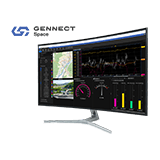
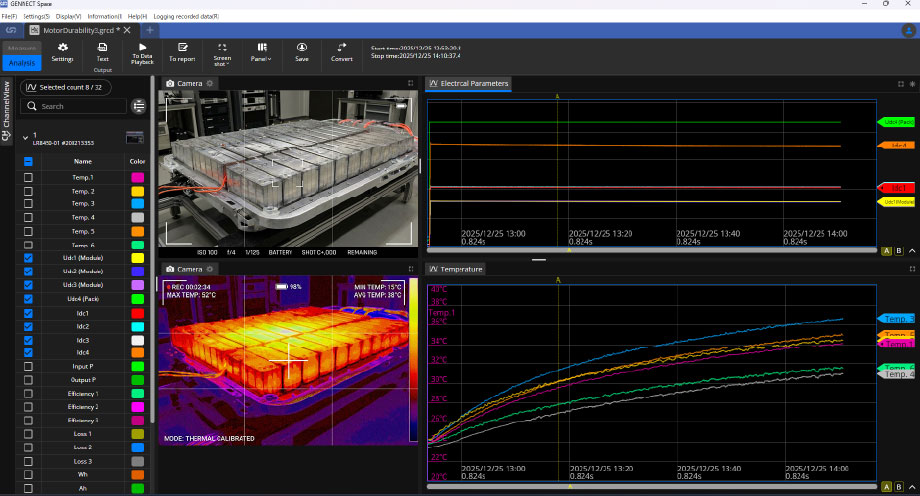
Gennect Space is an integrated data analysis software platform that allows measurement data acquired with HIOKI instruments to be visualized and analyzed intuitively. In addition to temperature waveforms recorded by data loggers, it can also handle USB camera images, thermography images, and other measurement data on a single PC screen.
Gennect Space is built around the simple concept:
Thermography × Waveform Synchronization
and this concept fundamentally changes the way temperature data is viewed and analyzed.
By simply scrolling along the time axis, you can simultaneously see:
- “Which part of the pack is generating heat at this moment,” and
- “How the temperature at each measurement point is changing at that time.”
As a result, the relationship between “location” and “time” can be understood intuitively, and the analysis of measurement results shifts from something you must think through to something you can understand at a glance.
System Configuration
In this application, the following system configuration is used to perform battery pack temperature measurement and analysis.
Memory HiLogger LR8450-01
The LR8450 is a portable data logger. It supports multiple measurement modules and can record multi-point measurement data as fully synchronized data. The wireless LAN model, LR8450-01, can connect to measurement modules wirelessly, enabling flexible, distributed measurement setups.
Thermistor Module LR8537
The LR8537 is a module that supports up to 15 channels of thermistor inputs. It supports thermistors with resistance values of up to 200 kΩ, allowing thermistors from different manufacturers and with different specifications to be used flexibly. It is well suited for temperature evaluation under the same conditions as the thermistors used in the BMS.
Voltage/Temperature Module LR8532
The LR8532 is a module that supports thermocouple-based temperature measurement with up to 30 input channels. It can also be used for battery cell voltage measurement, making it suitable for combined thermal and electrical evaluation.
Gennect Space
Gennect Space is HIOKI’s integrated data analysis software that covers instrument setup, data acquisition, and data analysis in a single environment.
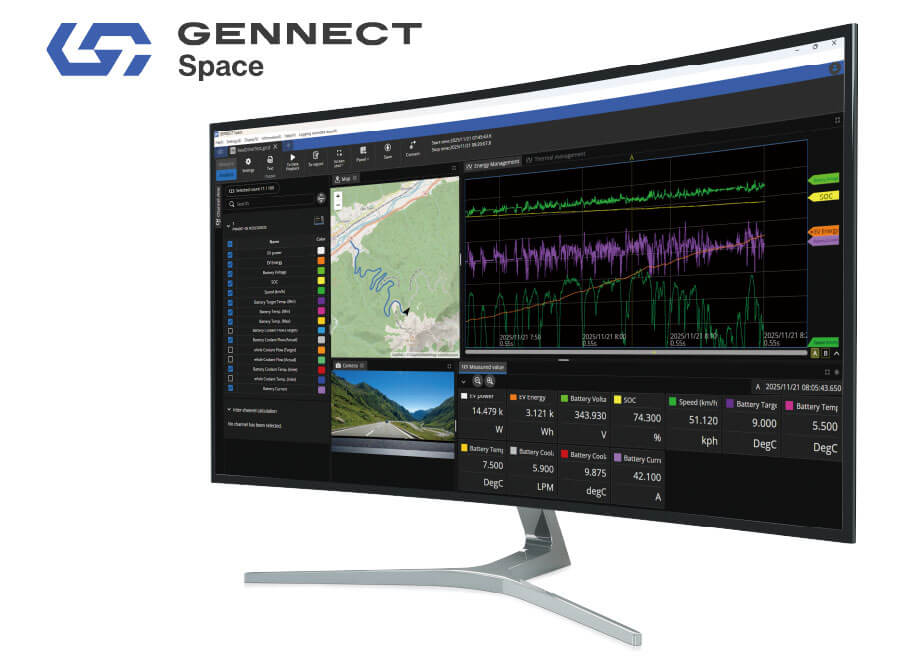
Experience data analysis with Gennect Space
In battery pack temperature evaluation, multi-point temperature measurement and an analysis environment that fully utilizes the results have a major impact on both development speed and reliability. Reducing the effort required before measurement and enabling review of the results afterward in an intuitive, “easy-to-understand at a glance” manner will become the standard approach to temperature evaluation going forward.
Gennect Space is available free of charge as software designed to enable this style of analysis.
Sample data is also provided, so we invite you to try Gennect Space and experience how it works in practice.