Data Center Commissioning and 5 Levels of Testing
Data center reliability and power supply
IT communications, including the internet, are now fundamental infrastructure that modern life depend on. Data centers host servers and network systems that power websites, AI applications, and data storage. Because these services must operate continuously, data centers are required to maintain stable 24/7/365 operation. Even a few seconds of downtime can severely impact society and businesses.
This article outlines the key systems that make up a data center, explains commissioning tests used to verify reliability, and highlights how electrical measuring instruments play critical roles in ensuring stable operation.
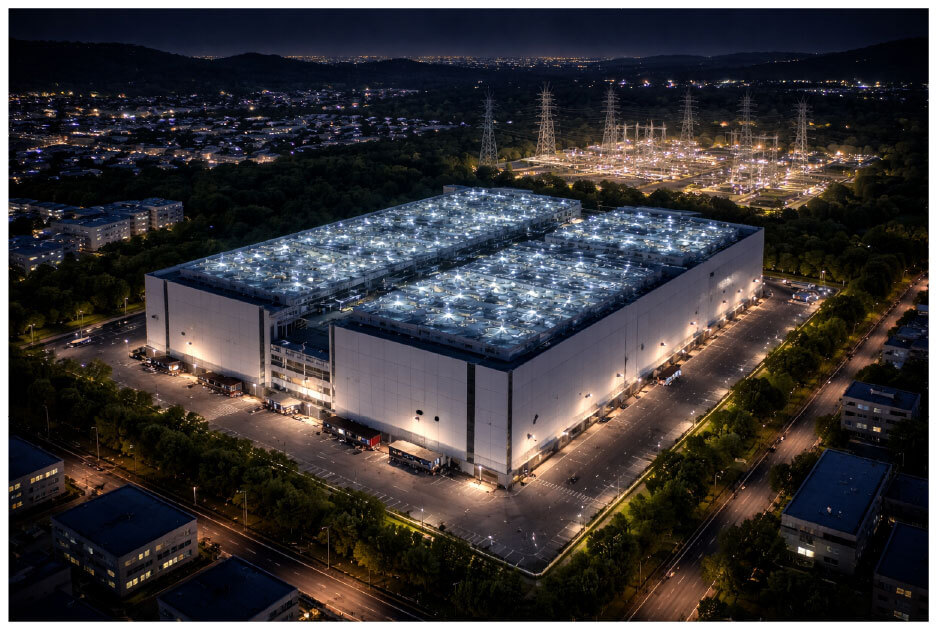 Data center and substation
Main systems that make up a data center
Data center infrastructure can be broadly divided into three categories:
- 1.Power systems
- 2.Cooling and air-conditioning systems
- 3.Servers and network equipment
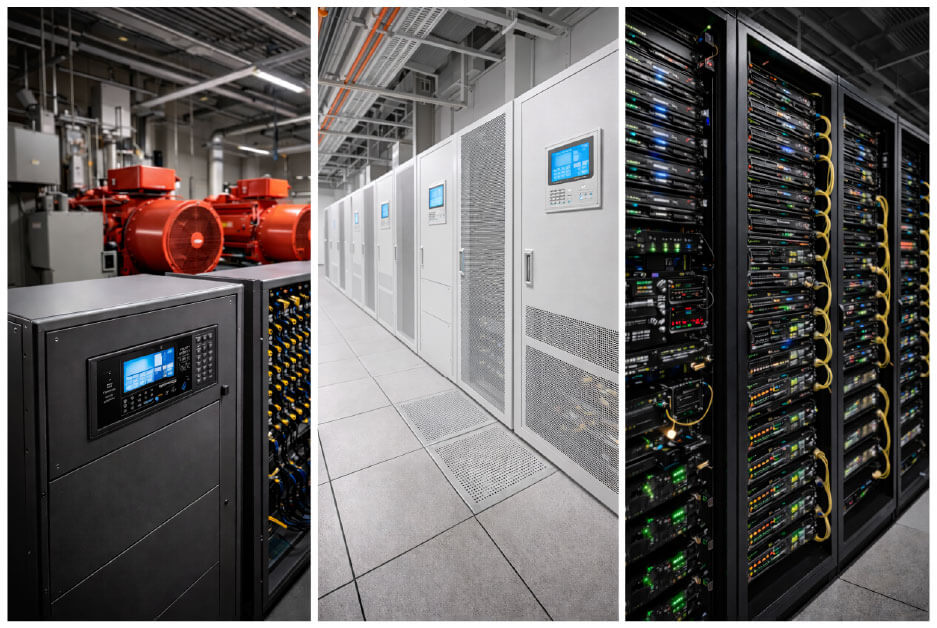
Power systems (generators, substations, UPS )
Because servers and storage systems run nonstop, they require a clean, stable, and uninterrupted power supply. Even momentary outages can cause system crashes or data loss. To prevent this, data centers implement highly redundant power architectures.
Typical components include:
- Utility power from nearby substations
- UPS systems to cover short interruptions
- Diesel generators (gensets) to supply power during extended outages
These systems are designed so that a backup source can immediately take over when a failure occurs.
Cooling and air-conditioning systems (air conditioners, chillers, cold aisles, hot aisles)
Servers generate significant heat in proportion to their power consumption. If the internal temperature of a server rises due to heat generation, it can lead to failure or shutdown. Therefore, effective cooling is essential for stable operation. The cold-aisle / hot-aisle method is a cooling scheme that separates the intake and exhaust paths of servers, preventing the mixing of cold supply air and hot exhaust air. Increasing power consumption in data centers is a major challenge, and the proportion of cooling and air-conditioning in the power consumption of large facilities is by no means small. Cooling efficiency becomes ever more important for both operational stability and energy savings.
Servers and network equipment (servers, GPUs, PDUs, racks)
The primary IT equipment in a data center is organized mainly into racks, which house:
- Servers and GPUs
- Power distribution units (PDUs)
- Network devices and structured cabling
AI computing has significantly increased rack power density, with many racks now drawing 10 kW – 20 kW or more. This demands high‑performance power delivery components such as voltage regulators, multiphase converters, and MLCCs capable of supporting rapid load fluctuations and high currents.
Redundancy in data centers
Because data centers support mission‑critical services—including finance, cloud platforms, and public infrastructure—uptime is a key metric. The most reliable data centers target annual downtime measured in minutes.
To achieve this, redundancy is built into the power system so operations can continue even during equipment failures. In top‑tier designs, every major component—including incoming utility lines, UPSs, generators, and power distribution—is fully independent across two isolated power paths.
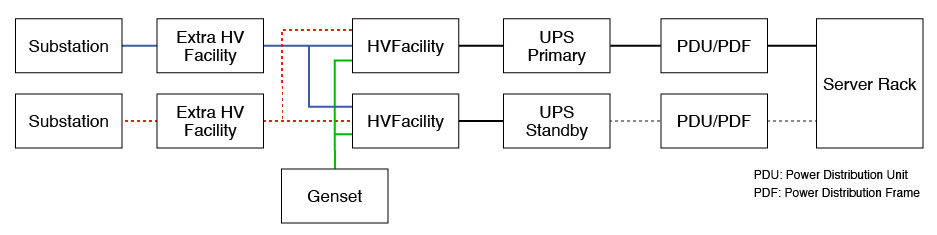
Example of the redundancy: Two independent power supply systems are connected
Commissioning tests
Newly built data centers undergo a rigorous verification process known as commissioning, which ensures all systems operate as intended.
Commissioning consists of five levels. The process progresses from factory testing of individual devices to on‑site installation checks, then to individual equipment tests, followed by system and subsystem testing, and finally concludes with integrated operational testing under actual load conditions. At each stage, measuring instruments are used to verify proper operation and ensure compliance with design specifications. Because the detailed verification items for each stage may vary depending on the requirements of the owner or developer, they must be reviewed and confirmed each time.
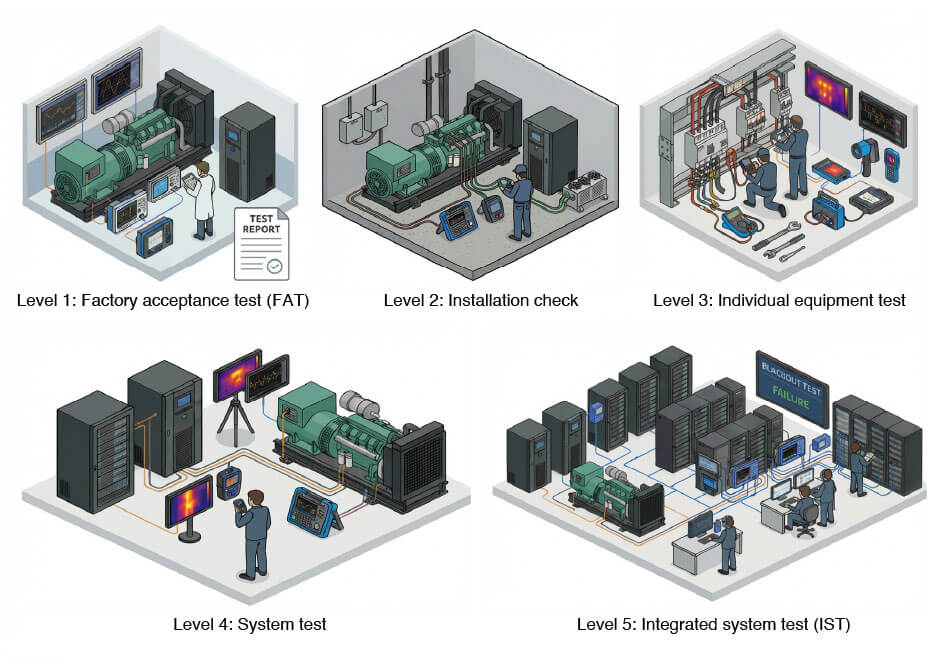
Level 0: Design review
Stakeholders examine the design to ensure it meets all requirements. Identifying issues at this stage is the most cost‑effective and is therefore crucial.
Level 1: Factory acceptance test (FAT)
Performed at the manufacturer’s site, FAT verifies that each device meets its specifications and is free from defects before shipment.
Level 2: Installation check
Equipment that has completed factory testing at Level 1 (FAT) is transported to the site and installed. After delivery and installation, equipment is inspected—before power‑on—to ensure transport or handling has not caused damage or performance degradation.
Level 3: Individual equipment test
This level confirms that each device installed on site operates in accordance with its specifications. By verifying device operation individually, this simplifies troubleshooting when systems are later integrated.
Level 4: System test
Each system is powered and tested individually in their actual installation environment to verify correct operation without cross‑system interaction.
Level 5: Integrated system test (IST)
All systems operate together under simulated real-world conditions. Failure modes such as utility outages, UPS failures, PDU faults, and combined worst‑case scenarios are tested to confirm overall resilience.
Hioki Measurement Solutions
Hioki offers a range of measurement tools widely used during commissioning and operation.
UPSs and Gensets Operation Tests
A common Integrated System Testing scenario is simulating a utility power loss. During this event:
- UPS systems instantly switch to battery mode
- Generators start and assume the load within seconds
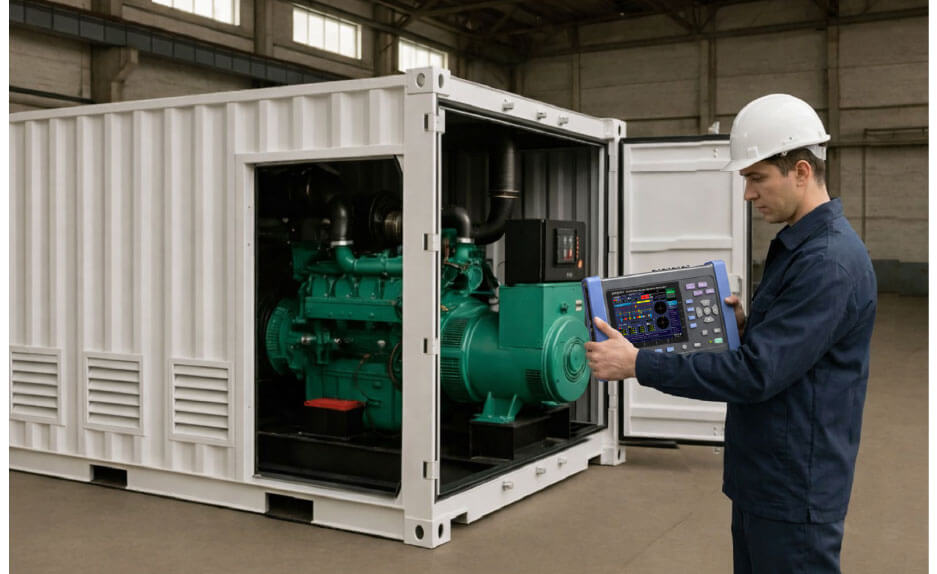
Worst-case scenarios, such as backup failures during outages, are also tested—requiring accurate monitoring of transient behaviour.
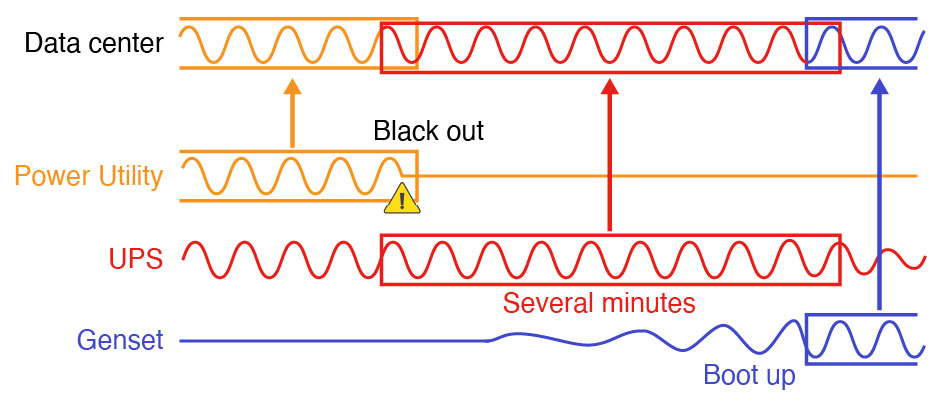 Schematic Diagram of Power Backup: When the utility line loses power, the UPS provides several minutes of backup time, during which the generator starts up. As a result, the data center experiences no downtime
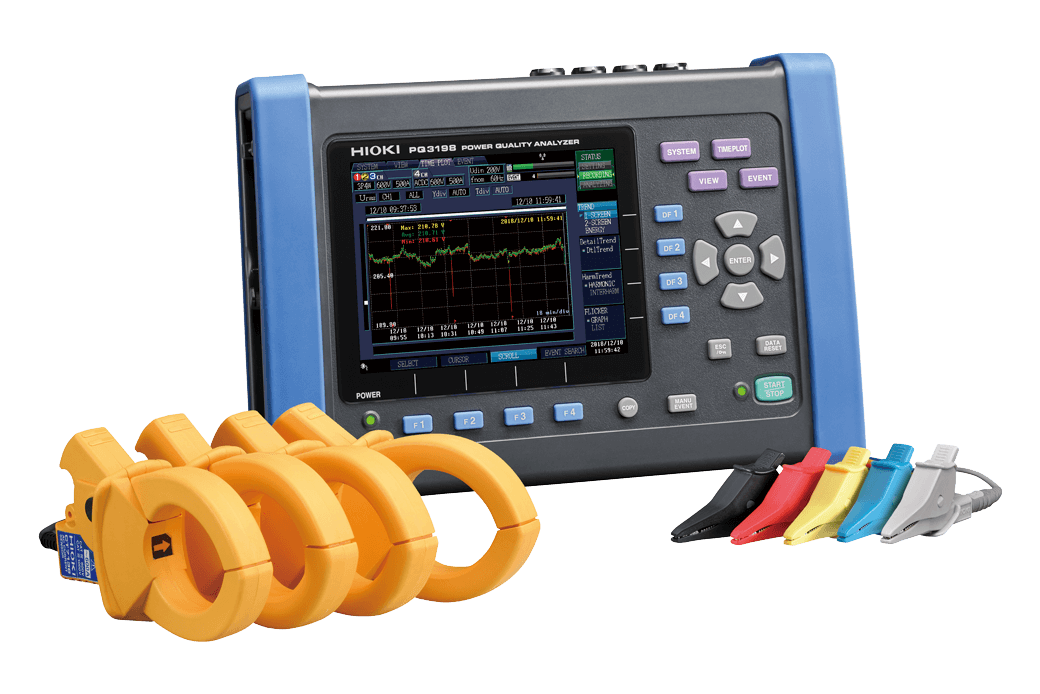
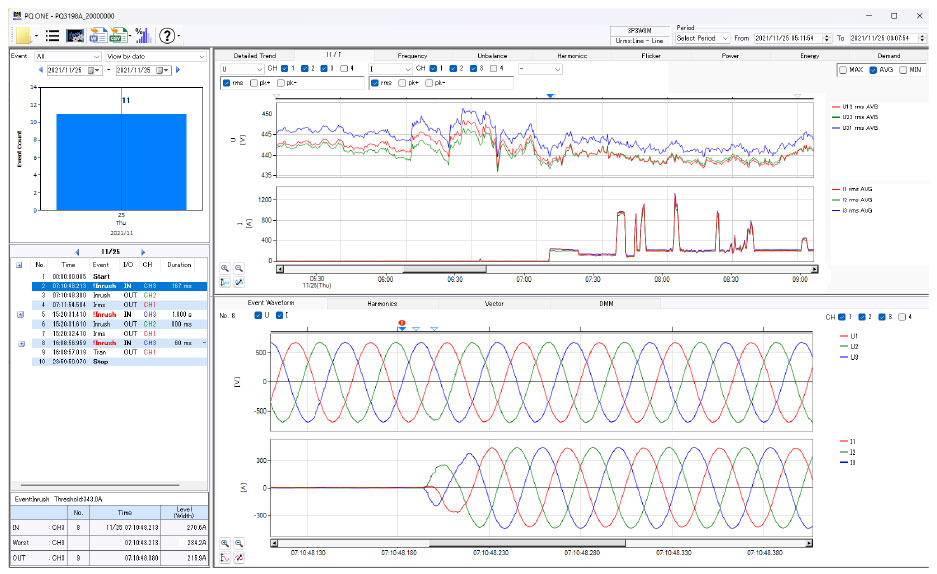 Example of load variation test with PQ3198: The voltage maintains a stable value regardless of load current fluctuations
Factory Acceptance Tests for Backup Equipment
Before shipment, UPSs and generators undergo witnessed FAT. Key test parameters include:
- Voltage and frequency stability
- Switchover transient response
- Harmonic performance
- Efficiency
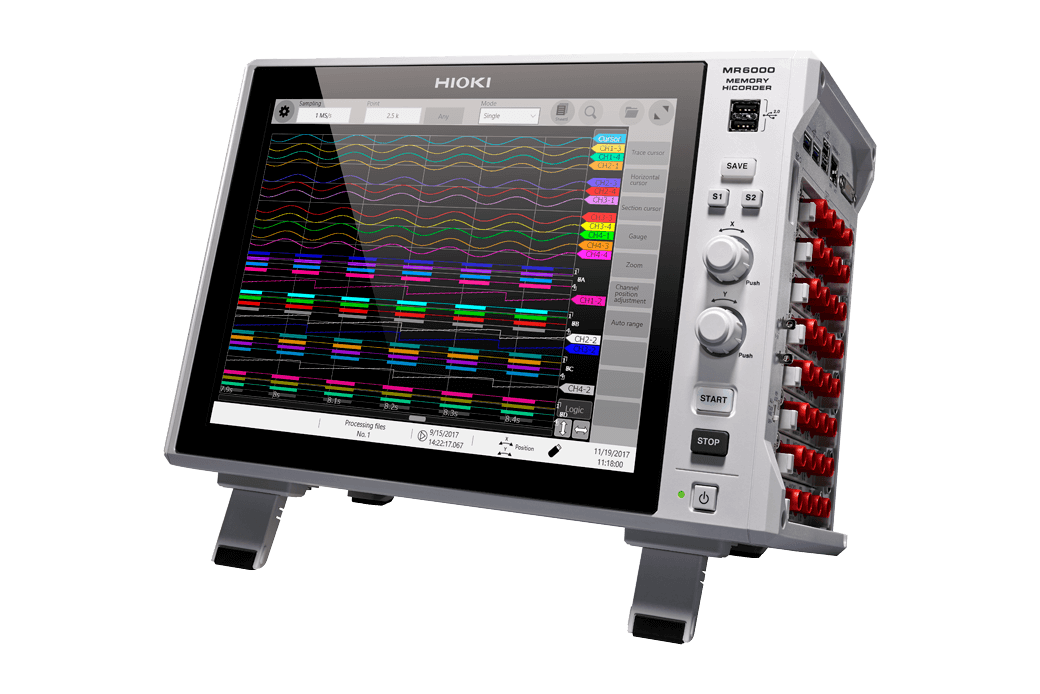
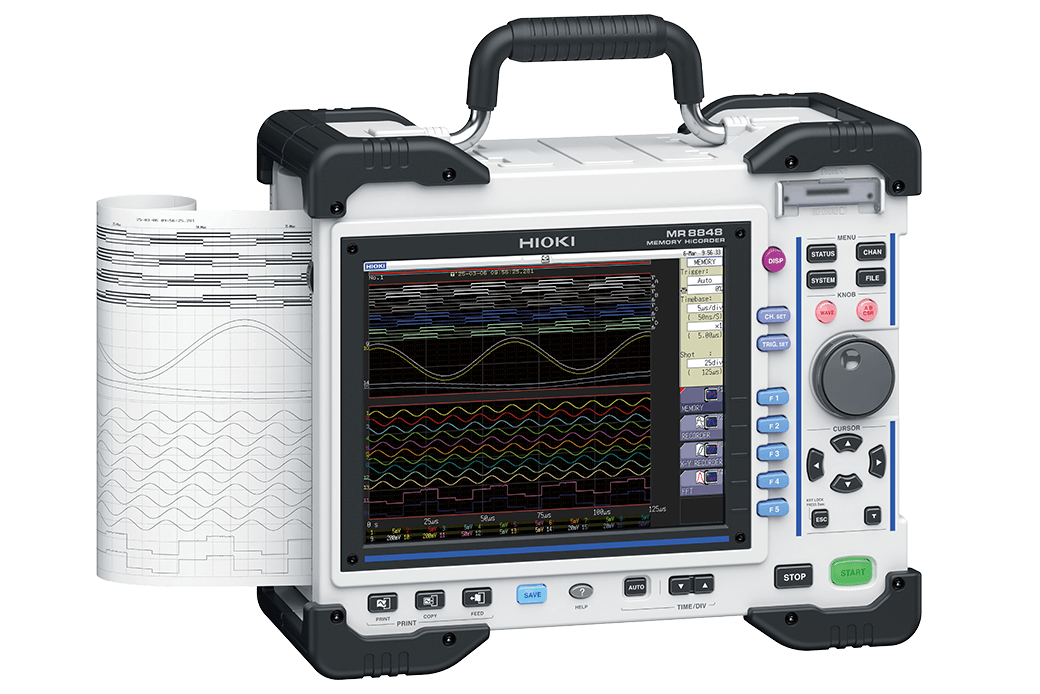
Power analyzers, power quality analyzers, and memory recorders are often used, sometimes in accordance with international standards.
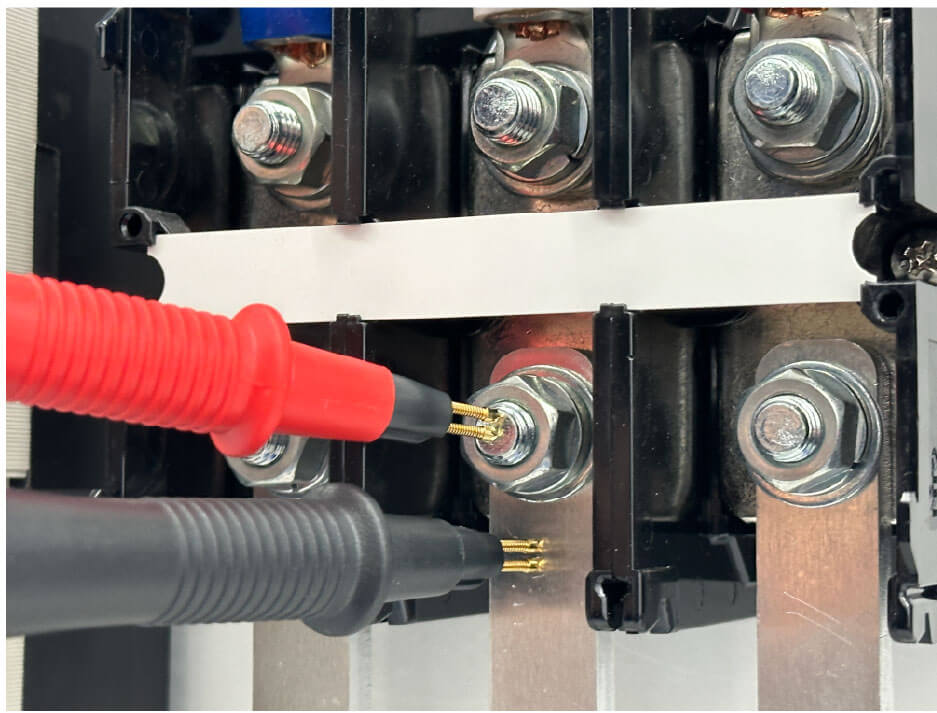
Preventing Heat‑Related Failures: Bolt Tightening Verification
High-power systems use bus ducts and heavy-current breaker connections.
If bolts are insufficiently tightened, contact resistance rises, causing overheating and potential fire.
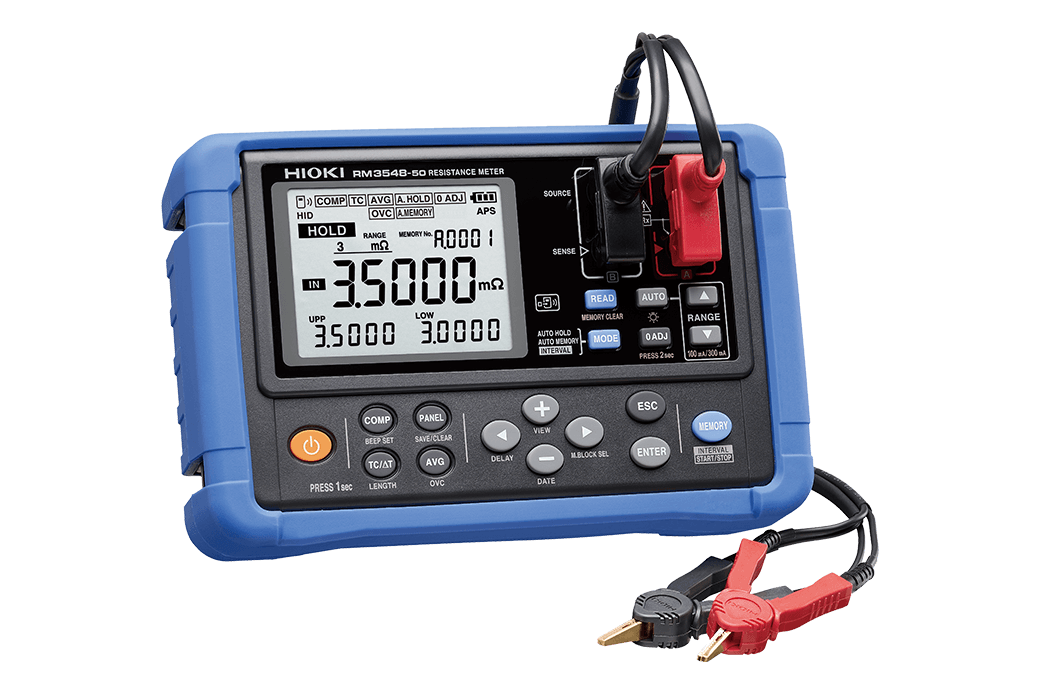
Hioki’s portable four-terminal resistance meters enable milliohm‑level verification to ensure safe, properly tightened connections.
Conclusion
Data centers are critical infrastructure supporting modern digital society. They must provide uninterrupted operation, often with extremely high availability requirements. The five-level commissioning process ensures all systems, from power and cooling to IT equipment, function as designed.
Hioki’s measurement instruments play an essential role throughout commissioning and ongoing maintenance. Accurate measurement enables reliable, safe, and highly available data center operation.