Evaluating Electrode Sheet Resistance to Detect Material Migration in Lithium-Ion Batteries
Introduction
To push the boundaries of energy density, manufacturers must first control the hidden structures within electrode sheets. Small changes in drying conditions shift material distribution inside the composite layer. When this migration goes undetected, it degrades cell output and undermines production consistency. These internal changes are difficult to identify through conventional methods. This application note demonstrates how resistance-based measurement with the Hioki RM2610 reveals material migration and supports more reliable process control.
Background
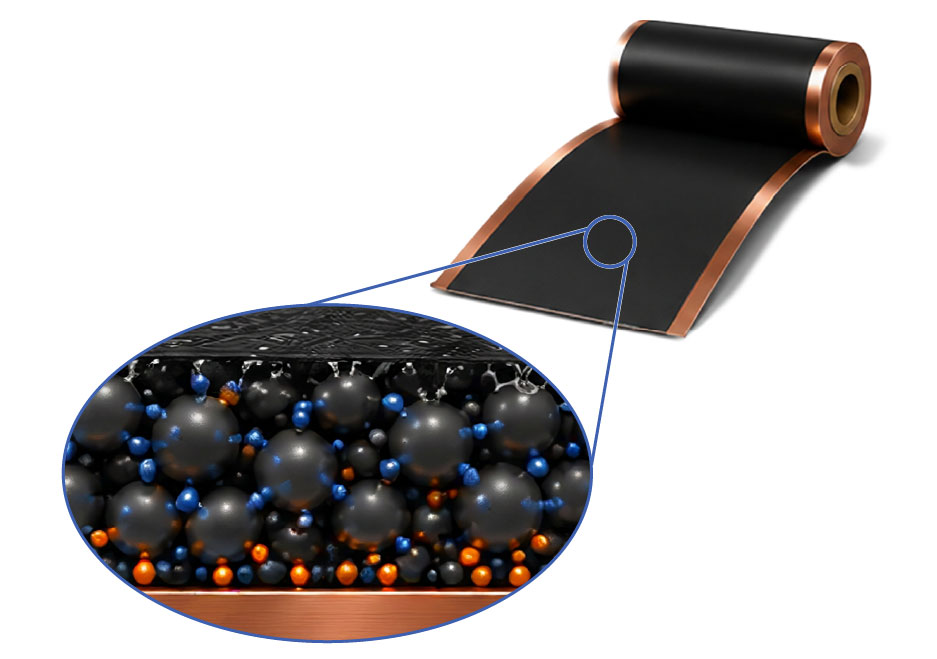
EV and energy storage manufacturers demand more from every battery cell: higher energy density, tighter consistency, and stable production at scale. Meeting these demands requires precise control of electrode sheet structure.
The drying process directly influences how binder and conductive additives are distributed within the composite layer. Even small variations in drying conditions can alter this distribution, introducing variability into electrode sheet performance and downstream cell characteristics.
Conventional structural analysis methods, such as microscopy, provide detailed insight but are not well suited for iterative process development or direct comparison of process conditions.
Because material migration directly affects conductive pathways and interface contact, changes in composite resistivity and interface resistance provide direct indicators of internal structural variation.
Problem
During drying, material migration within the composite layer disrupts the intended structure.
At elevated temperatures:
- Binder migrates toward the upper surface
- Conductive additives follow this movement
This creates a non-uniform distribution across the electrode sheet thickness, leading to:
- Variation in electrode sheet performance
- Increased cell-to-cell variability
- Reduced output performance and efficiency
- Weakened adhesion between the composite layer and current collector
- Greater risk of defects such as delamination
Without a practical way to detect these changes directly, engineers must rely on indirect indicators or structural analysis methods that do not readily support process comparison.
Mechanism of Material Migration
Fig. 1 illustrates the migration process during drying. At 90 °C, binder and conductive additives remain uniformly distributed. At 150 °C, the binder migrates toward the upper surface. As it moves, conductive additives are drawn upward, concentrating away from the current collector. This redistribution weakens the conductive network at the interface, degrading electrical contact and increasing interface resistance.
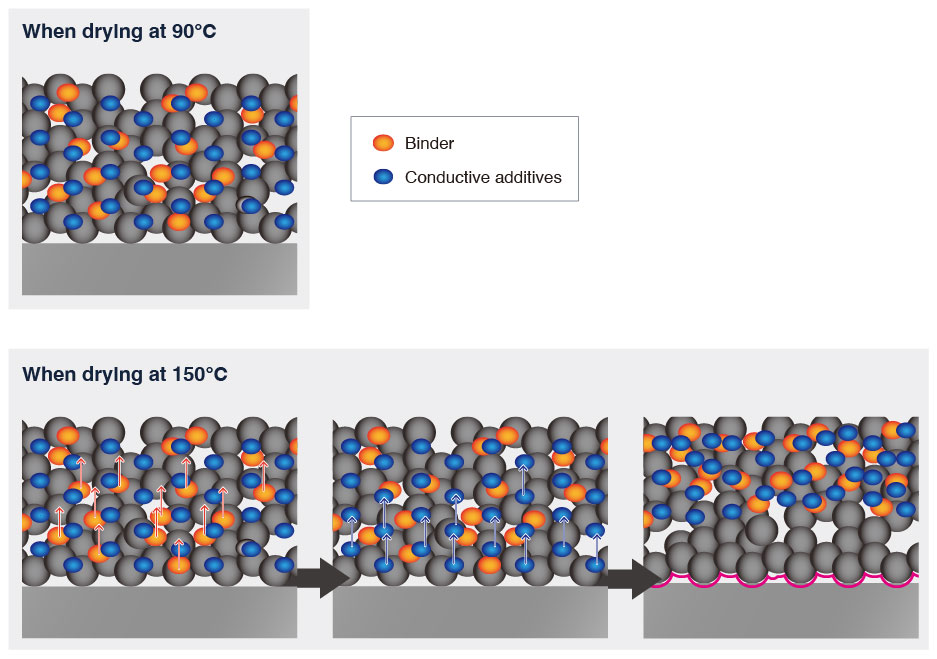 Fig. 1. Illustration of binder and conductive additive migration during drying. At elevated temperatures, binder migrates upward, drawing conductive additives with it and degrading interface contact.
Measurement Method and Setup
The RM2610 measures:
- Composite resistivity
- Interface resistance between the composite layer and current collector
By separating these two parameters, the system isolates changes occurring within the composite layer from those at the interface.
Because material migration alters both conductive pathways and interfacial contact, these measurements provide a direct, quantitative view of structural change within the electrode sheet.
Fig. 2 shows the measurement configuration.
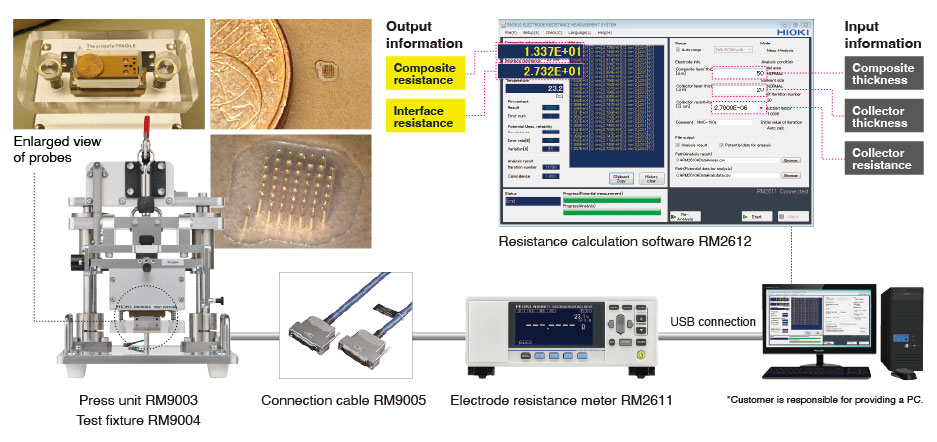 Fig. 2. Measurement configuration using the RM2610.
Measurement Results
Fig. 3 shows the relationship between drying temperature and interface resistance.
- At 90°C, interface resistance is approximately 0.1 Ω·cm2
- At 150°C, interface resistance increases to approximately 0.6 Ω·cm2
This is a sixfold increase resulting from the change in drying temperature. The data at 150°C also shows greater variation, indicating reduced process stability under higher-temperature conditions.
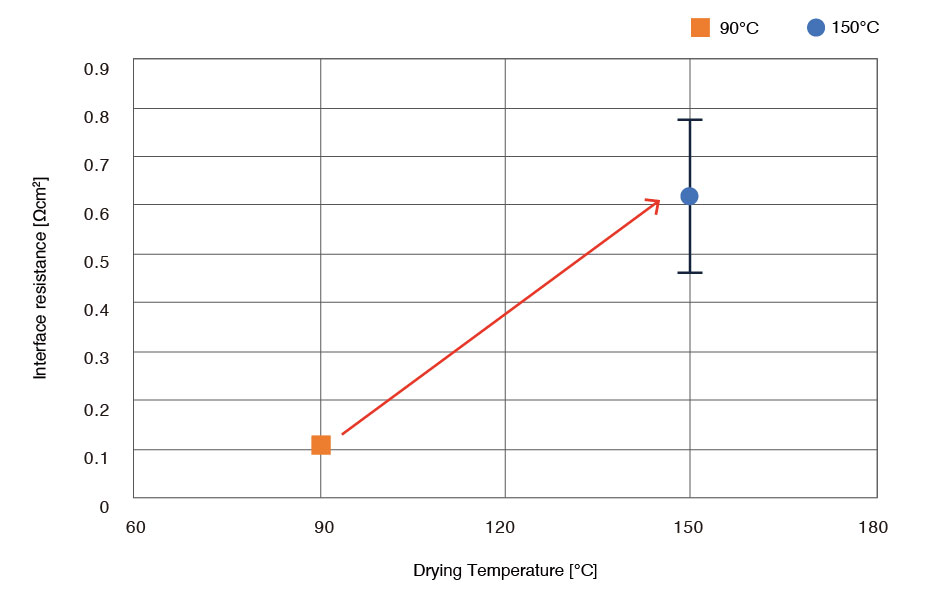 Fig. 3. Relationship between drying temperature and interface resistance.
Linking Measurement to Mechanism
The increase in interface resistance shown in Fig. 3 directly corresponds to the migration behavior illustrated in Fig. 1.
- Upward migration of binder and conductive additives
- Depletion of conductive material near the current collector
- Degraded electrical contact at the interface
Together, these effects explain the observed rise in interface resistance. This demonstrates that resistance measurement serves as a direct method to detect structural changes caused by process conditions.
Benefits
Using the RM2610, engineers can:
- Detect material migration in electrode sheets
- Quantify the impact of drying conditions
- Compare process conditions directly
- Reduce trial-and-error during process development
- Improve consistency in electrode sheet manufacturing
By identifying structural issues earlier in the process, engineers can make more informed decisions.
Conclusion
Material migration during electrode sheet drying degrades performance and introduces variability. These changes originate in the internal structure of the composite layer and at its interface with the current collector.
By measuring composite resistivity and interface resistance separately, the RM2610 provides clear, quantitative insight into these structural changes.
This approach enables earlier detection of process-induced variation and supports more effective optimization of manufacturing conditions.
For detailed product information, please visit our website. For a demonstration or consultation on a specific application, please contact us.