


Seminar Registration Closed Feb. 03, 2026
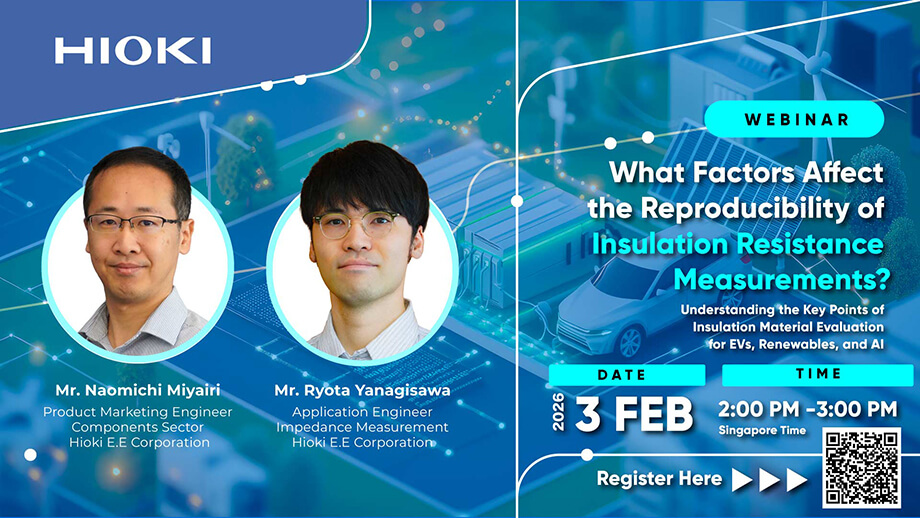
[Webinar] What Factors Affect the Reproducibility of Insulation Resistance Measurements?
Updates : Jan. 28, 2026
As electric vehicles (EVs), renewable energy systems, and AI data centers continue to evolve, power electronics systems are rapidly moving toward higher voltage operation, higher power density, and faster switching speeds. These trends place increasingly strict requirements on insulation materials, insulation resistance measurement, and high-voltage testing methods.
Insulation resistance measurement is a fundamental technique for evaluating insulation performance and reliability. However, as measurement targets move into the ultra-high resistance range (1016 Ω and above) and test voltages exceed 1000 V, achieving reproducible insulation resistance measurements has become significantly more challenging.
Challenges in Insulation Resistance Measurement Reproducibility
In real-world testing environments, insulation resistance measurement results are often strongly influenced by:
- Measurement setup and wiring configuration
- Test fixtures and guarding techniques
- Environmental conditions such as temperature and humidity
- Grounding and noise interference
- Operator-dependent test procedures
Even small variations in these factors can cause large fluctuations in measured insulation resistance values. In many cases, engineers may not realize that measurement variability is caused by the test setup itself rather than the insulation material or device under test.
As a result, poor measurement reproducibility can lead to:
- Unreliable insulation material evaluation
- Inconsistent quality and reliability assessment
- Difficulty comparing results across different test conditions or laboratories
Webinar Overview: Improving Insulation Resistance Measurement Reproducibility
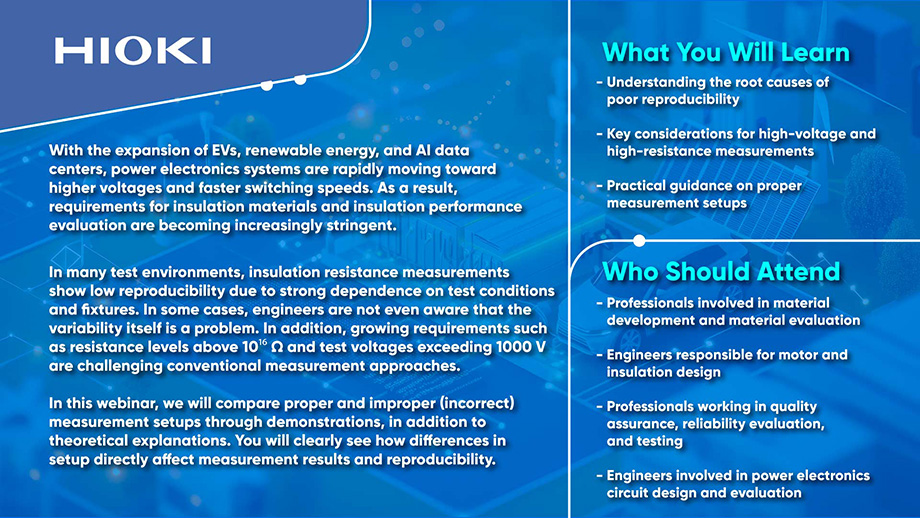
This technical webinar focuses on the key factors affecting insulation resistance measurement reproducibility in high-voltage and high-resistance testing applications. The webinar is designed as a technical knowledge-sharing session, combining theory with practical demonstrations to help engineers better understand:
- Why insulation resistance measurements vary
- How measurement setup impacts test stability and repeatability
- Common sources of error in high-voltage insulation testing
- Best practices for improving insulation resistance measurement accuracy
Through side-by-side demonstrations of proper and improper measurement setups, participants will clearly see how setup choices directly influence measurement results and reproducibility.
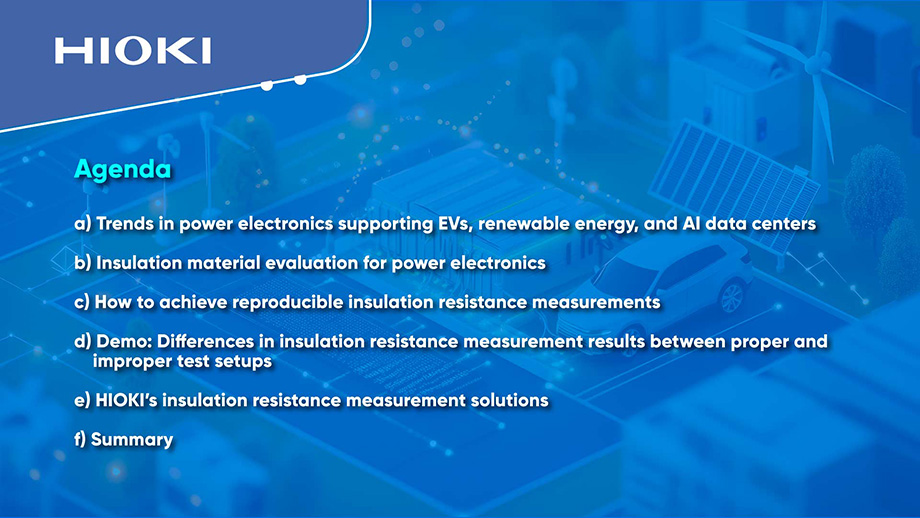
Key Learning Topics
- Deeper understanding of root causes of poor insulation resistance measurement reproducibility
- Key considerations for high-voltage insulation testing and ultra-high resistance measurement
- Practical guidance on measurement setup design, including wiring, fixtures, and guarding
- Insights into how measurement methodology affects insulation performance evaluation and reliability testing
For engineers and professionals involved in:
- Insulation material development and material evaluation
- Motor insulation design and validation
- Quality assurance and reliability testing
- Power electronics circuit design and evaluation
- EV systems, renewable energy inverters, and data center power equipment
Webinar Details
- Date: 3 February 2026 (Tuesday)
- Time: 14:00 PM to 15:00 PM Singapore Time (SGT)
- Location: Online (Zoom)
- Language: English
