Why High Current Can Distort Power Consumption Measurement
How current peaks, overrange conditions, and sensor magnetization affect measurement accuracy
In applications such as EVs, inverters, motors, power supplies, and power conditioners, it is important to measure not only steady-state current but also the sudden high-current peaks that occur during start-up and high-load operation.
Even if the rated current of a current sensor appears sufficient, inrush current or transient current peaks may exceed the sensor's measurement range. When this happens, errors can occur in integrated current consumption and power consumption measurements.
This article explains why unexpected high current can affect power measurement results and what to check when selecting or reviewing a current sensor for high-current measurement.
Current peaks can be much higher than steady-state current
Many types of equipment generate inrush current at power-on or start-up. In circuits that include motors, transformers, capacitors, or similar loads, the instantaneous current can be much higher than the current during normal operation.
Typical examples include the following:
| Load type | Component | Typical inrush current |
|---|---|---|
| Resistive load | Heater | Approx. 1× |
| Inductive load | Relay | Approx. 2–3× |
| Solenoid | Approx. 10× | |
| Motor | Approx. 5–10× | |
| Lamp load | Light bulb / Halogen lamp | Approx. 10–15× |
| Capacitive load | Capacitor | Approx. 20–50× |
| Transformer load | Transformer | Approx. 10–20× |
If a current sensor is selected based only on steady-state current, it may not be able to capture these momentary peaks within its measurement range.
When current exceeds the measurement range, the waveform can be clipped
When the current exceeds the measurement limit of a current sensor, the actual peak current may be clipped in the measured waveform.
This means that the peak still exists in the actual circuit, but the measured waveform is limited at the sensor's upper range. As a result, the peak current is recorded lower than its true value.
Because current consumption and power consumption are calculated by integrating measured values over time, the missing peak area can cause the integrated result to be lower than the actual value.
This is especially important when evaluating power consumption that includes start-up current, inrush current, or short-duration current peaks during high-load operation. Even a momentary overrange condition can affect the final integrated result.
Excessive current can also magnetize the sensor core and cause offset error
Another important factor is magnetization of the current sensor.
Current sensors that use a magnetic core may retain residual magnetic flux after excessive current flows through the conductor. This residual magnetization can cause a slight offset in the measured current, even after the actual current returns to zero.
At first glance, this offset may appear small. However, in long-term current consumption or power consumption measurement, even a small offset can accumulate as an error in the integrated value.
In other words, excessive current can affect measurement in two ways: it can prevent the current peak itself from being measured correctly, and it can also influence the measured value after the peak has passed.
Current waveform
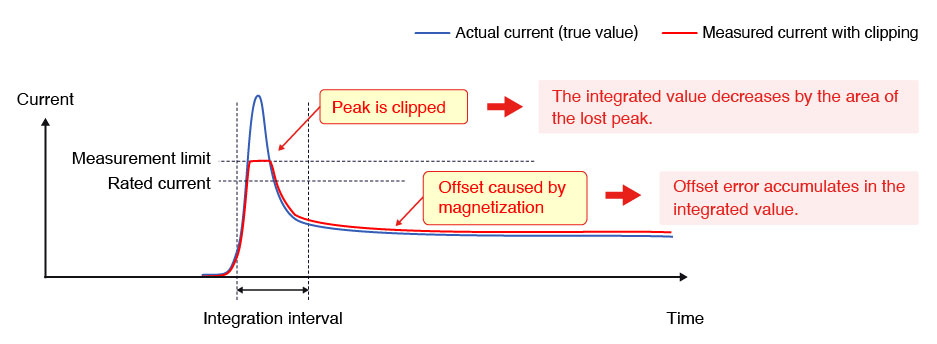 Fig. 1. Clipping of current peaks and offset due to magnetization cause errors in the integrated value
The effect of magnetization depends on sensor design
Magnetization can occur in current sensors that use a magnetic core. However, the magnitude of its effect depends on the sensor design.
For example, when comparing an older sensor design with a newer design, there may be a difference in offset change after excessive current is applied. A well-designed current sensor can reduce zero-point shift caused by residual magnetization.
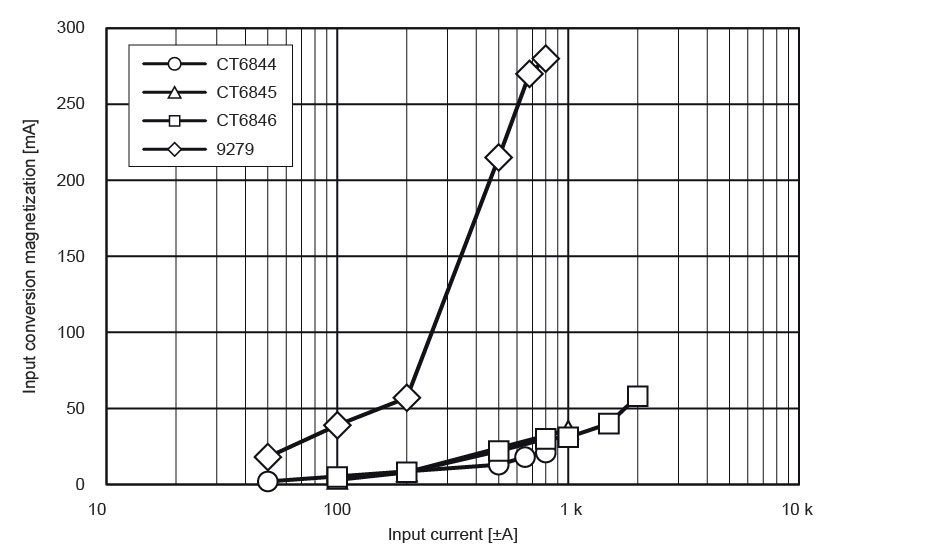 Fig. 2. Differences in the effects of magnetization by current sensor
Using the CT6846 rated at 1000 A as an example, measuring 2000 A (twice the rated current) produces a magnetization offset error of about 70 mA, or 0.07% of the rated current.
Numerical power analyzer results alone may not reveal overrange conditions
In power consumption measurement, engineers often evaluate average power, integrated energy, efficiency, or other numerical results. However, these values alone may not clearly indicate whether the current waveform was clipped or whether offset error occurred due to magnetization.
For this reason, high-current measurement should include the following checks:
- Identify current peaks during start-up and load changes
- Check the waveform for clipping
- Check for zero-point shift or offset after excessive current
Key points when selecting a current sensor for high-current measurement
Selecting a current sensor with a higher rated current is not always the best solution. The sensor should be selected based on the measurement purpose and actual measurement conditions.
| Item to check | Description | Points to consider |
|---|---|---|
| Rated current | Current range in which the sensor can measure accurately | Consider not only steady-state current but also peak current |
| Maximum peak current | Maximum current the sensor can withstand without damage | This is not the same as the range in which accurate measurement is guaranteed |
| Output rate | Sensor output sensitivity relative to input current | Higher-current sensors generally have lower sensitivity |
| Frequency bandwidth | Frequency range over which the sensor can follow current changes | Important for transient phenomena and switching components |
| Sensor size | Clamp diameter, body size, and installation requirements | Higher-current sensors tend to be larger |
| Operating temperature range | Temperature range over which the sensor specifications are guaranteed | Important for vehicle testing and environmental testing |
| Effect of magnetization | Offset change after excessive current | Important for long-term integration and high-accuracy measurement |
In high-current measurement, it is important to avoid waveform clipping caused by insufficient sensor range. At the same time, selecting a sensor with an unnecessarily high current rating may reduce current resolution because the output sensitivity tends to be lower.
The best sensor should be selected by considering maximum current, required resolution, frequency content, installation space, operating temperature, and the measurement instrument being used.
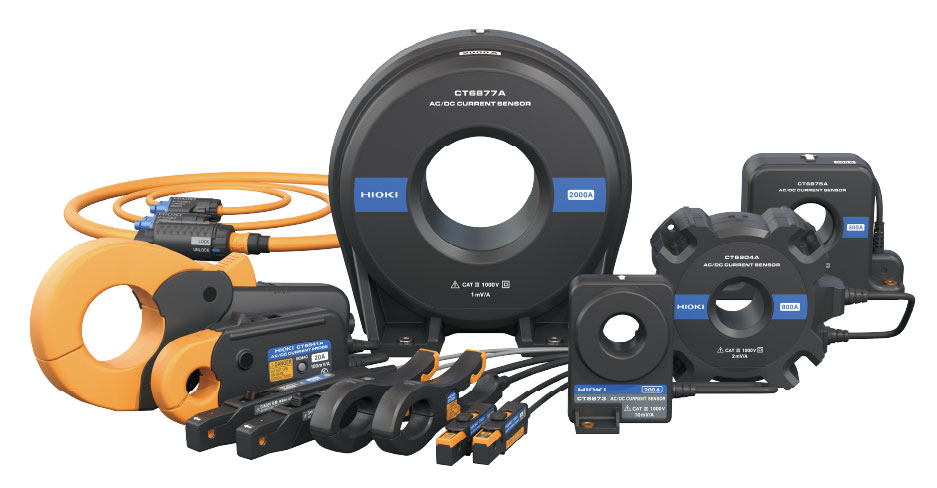
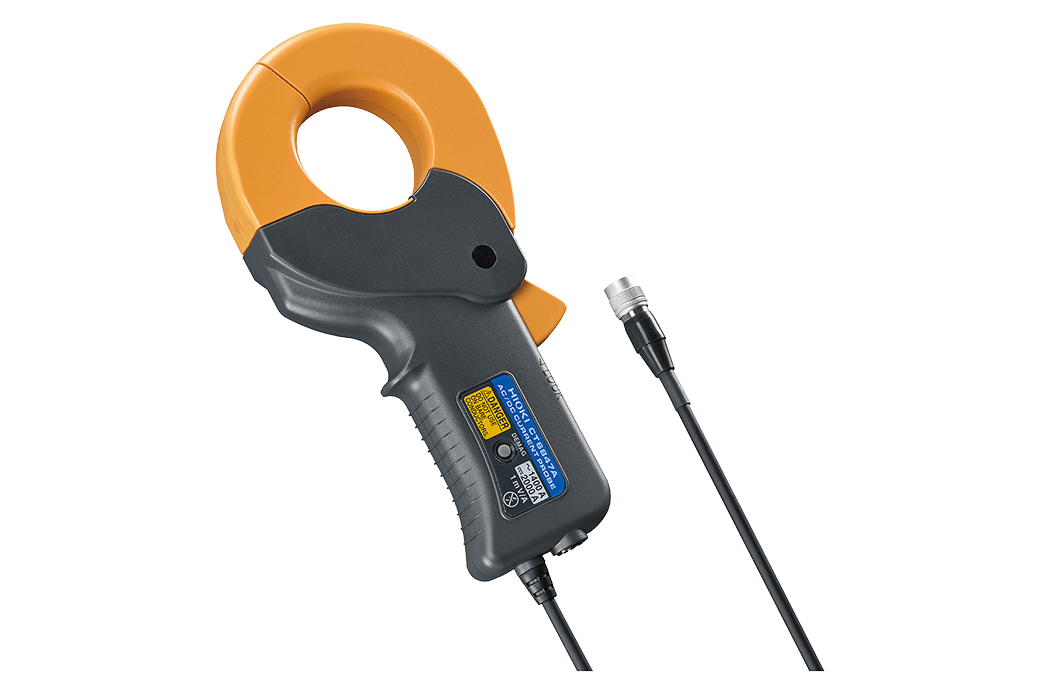
Example of a current sensor for high-current measurement: CT6847A
For power measurement involving high current, it is important to select a current sensor that matches the current range of the application.
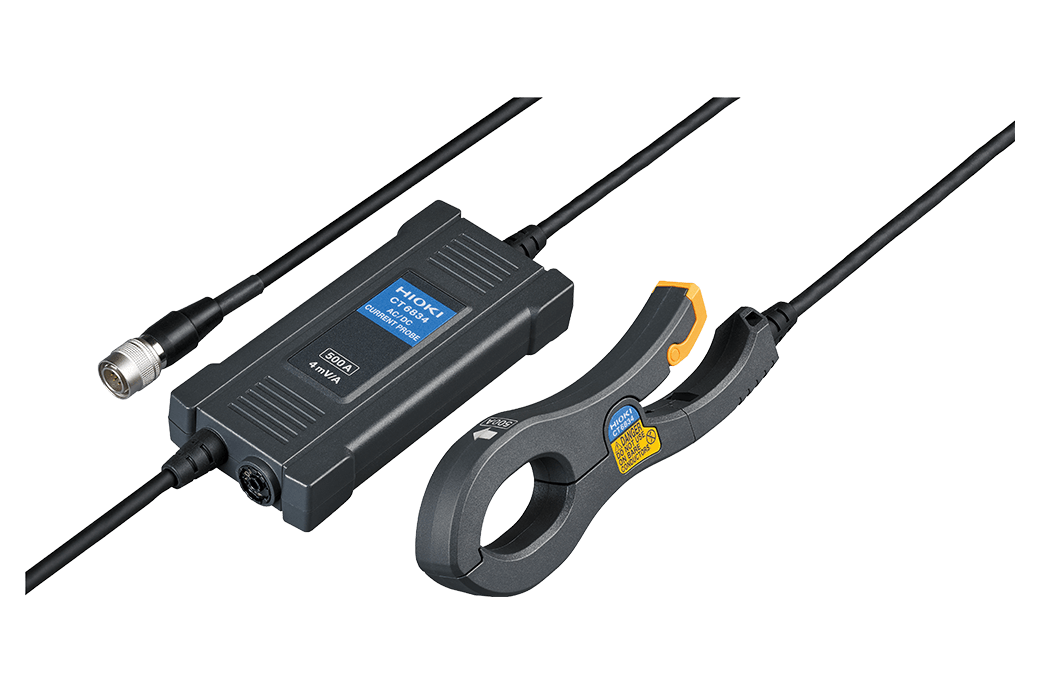
Hioki's AC/DC Current Probe CT6847A is a clamp-type current sensor that supports 2000 A DC and 1400 A AC measurement. It can be used in applications where currents exceeding 1000 A need to be measured, such as EVs, motors, inverters, and power conditioners.
Key specifications include:
| Item | CT6847A |
|---|---|
| Rated current | 2000 A DC, 1400 A AC |
| Frequency bandwidth | DC to 70 kHz |
| Maximum peak current | ±2400 A peak |
| Core diameter | φ50 mm |
| Operating temperature range | -40°C to 85°C |
| Detection method | Fluxgate, zero-flux current sensor |
The CT6847A is one option for high-current measurement. However, the most suitable current sensor depends on the current level, required accuracy, frequency bandwidth, installation conditions, operating temperature, and the measurement instrument used.
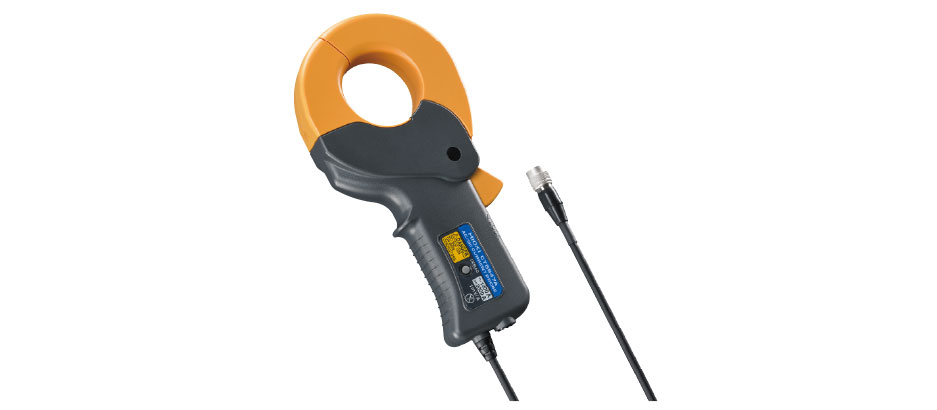 AC/DC Current Probe CT6847A
Summary: Current peaks and sensor characteristics must be considered in high-current measurement
To measure current consumption and power consumption accurately, it is not enough to consider only steady-state current. Current peaks that occur during start-up, inrush, and high-load operation must also be taken into account.
When current peaks exceed the sensor's measurement range, waveform clipping can cause the integrated value to be lower than the actual value. In addition, excessive current may magnetize the sensor core, resulting in offset error that can accumulate in long-term integrated measurements.
When selecting a current sensor for high-current measurement, it is important to review rated current, maximum peak current, output rate, frequency bandwidth, sensor size, operating temperature range, and the effect of magnetization.
Consult us about current sensor selection for high-current measurement
The best current sensor depends on the current peak, required accuracy, frequency bandwidth, installation space, operating environment, and measurement instrument. Hioki supports current sensor selection for high-current measurement in applications such as EVs, motors, inverters, power supplies, and power conditioners.
For detailed product information, please visit our website.
If you would like a product demonstration or consultation for a specific application, please contact us.
If you have challenges with high-current measurement, our team can help you find the most suitable current sensor for your application.