


Solving a Green Hydrogen Problem
Achieving cell and stack-level electrolyzer diagnostics at industrial scale with Hioki ALDAS-E: solving a green hydrogen problem
Executive Summary
When Verdagy built a 100kW industrial alkaline water electrolyzer, the firm needed cell and stack-level diagnostics — detail that conventional testing methods could not provide. Using Hioki’s ALDAS-E, the team conducted operando Electrochemical Impedance Spectroscopy at up to 4,800 A — gathering diagnostic data without disrupting the electrolyzer’s operations. Hioki’s equipment was able to accurately detect AC signals in the presence of large DC currents — allowing Verdagy to run full diagnostics on each electrolysis cell individually at real operating conditions, and allowing the firm to produce green hydrogen at costs competitive with fossil fuels, powering the green hydrogen boom.
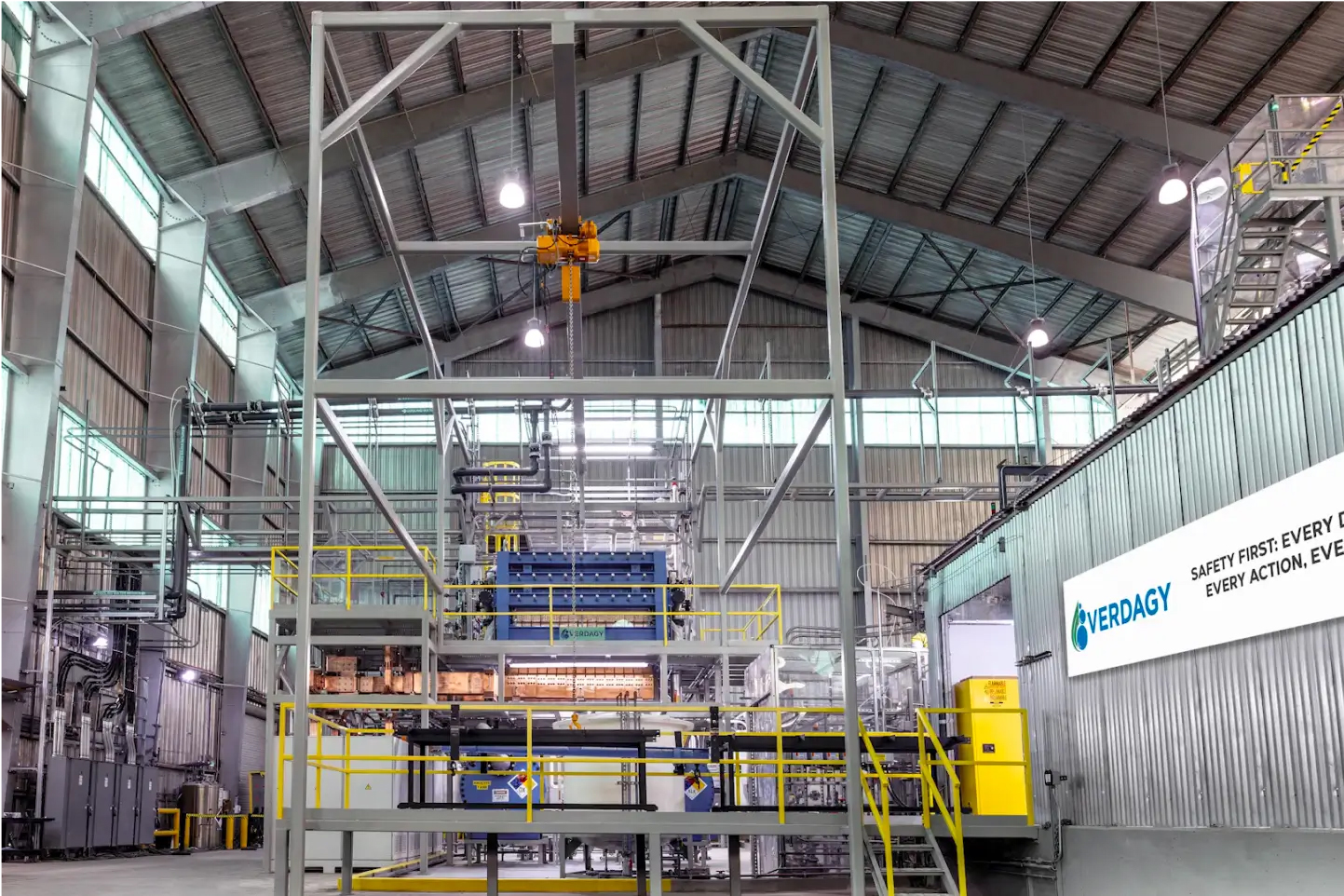
Image Source: https://verdagy.com/product-electrolyzers-clean-hydrogen/
Green hydrogen production is critical to decarbonisation efforts in certain industrial sectors — like steelmaking, ammonia synthesis, and chemical manufacturing. But optimising industrial electrolyzers is not a straightforward engineering task — industrial alkaline water electrolysis typically comprise hundreds of cells, introducing significant challenges for real-time monitoring and electrochemical diagnostics.
Verdagy, a US-based manufacturer of advanced alkaline water electrolyzer systems, is working to develop industrial-scale equipment for green hydrogen production, with its flagship 20 MW eDynamic® system designed to produce hydrogen at costs competitive with fossil fuels.
But with stack performances shaped by a web of complex processes — electrochemistry at the anodes and cathodes, and the movement of ions through the diaphragm — each cell within a stack may behave differently depending on its electrode materials, membrane configuration, and position within the flow manifold.
Engineers use electrochemical impedance spectroscopy (EIS), a diagnostic technique that probes the internal behaviour of an electrochemical system, to measure electrolyzer performance.
By applying a small alternating electrical signal across a range of frequencies and measuring how the system responds, engineers can identify distinct internal processes, such as charge transfer and ion movement, that a simple voltage-current measurement cannot separate, giving them a far more detailed picture of what occurs inside the stack, and where performance can be improved.
But methods to conduct EIS measurements on industrial scale alkaline electrolyzer stacks while they were in service — operando — have been extremely limited. Verdagy needed a measurement technique that could deliver cell-level resolution — and deliver it at current levels representative of real industrial operation, without interrupting the stack.
HIOKI’s solution
Verdagy worked with Hioki to deploy the ALDAS-E (Active Line Device Analysis System) on a 100 kW demo-scale alkaline water electrolyzer stack — five cells in series, with 3,000 cm² electrodes (100 cm × 30 cm), operating at 90°C in a 25–35 wt% potassium hydroxide solution.
Hioki’s ALDAS-E superimposes a tiny AC ripple on top of the existing DC current, and measures the voltage response across individual cells simultaneously. With its measurement approach using a fluxgate current sensor, Hioki’s ALDAS-E was the perfect solution in monitoring stack performance, allowing the firm to measure electrolysis cell without taking production offline.
Measurements were taken at DC currents from 100 A to 4,800 A, sweeping frequencies from 100 kHz to 10 mHz across 50 points — capturing the electrochemical activity within the stack. The study focused on two cells built with different electrode and membrane specifications to evaluate performance differences directly.
Results
HIOKI’s ALDAS-E helped confirm data quality well within acceptable thresholds for rigorous analysis, the researchers found. The team identified distinct processes within the stack — oxygen generation at the anode, hydrogen generation at the cathode, and ion movement through the diaphragm — and tracked how each responded as current increased using Distribution of Relaxation Times (DRT) analysis.
Significantly, ALDAS-E enabled resistance measurements at the individual cell and stack level across a range of operating conditions, something conventional polarization curve testing could not do.
This allowed the team to directly compare two cells built with different electrode and membrane materials, and quantify the performance difference between them.
“For anyone doing serious electrolyzer development work, the ability to measure at this level of detail, at genuine industrial conditions, makes a real difference.”
— Carlos Valero-Vidal, Electrochemical Scientist, Verdagy Inc.
Read the full testimonial here.
Impact
The study confirms that detailed electrochemical diagnostics, previously limited to laboratory settings, can now be performed reliably on full-scale industrial equipment. For Verdagy, the findings directly inform the development of its 20 MW eDynamic® electrolyzer and its goal of producing green hydrogen at costs that can compete with fossil fuels. For the wider industry, it signals that this level of diagnostic precision is no longer out of reach at commercial scale — and that Hioki’s ALDAS-E is the tool that makes it practical.
The collaboration was presented publicly at the 249th Electrochemical Society Meeting in Seattle, May 2026 — one of the most prominent forums in the global electrochemistry community — as Paper 216975.
Find out more about the ALDAS-E
To learn how Hioki’s ALDAS-E can support your electrolyzer development and diagnostic programme, contact your local Hioki representative or visit the product page.