


News Sep. 11, 2026
HIOKI Engineer Wins Best Paper Award at IPEC 2026 for High-Frequency Loss Analysis Model for Next-Generation Motor Design
Hioki engineer Masakazu Akahane’s proposal, accounting for hidden capacitance and inductance in cables and motor windings, will help engineers pin down losses in performance.
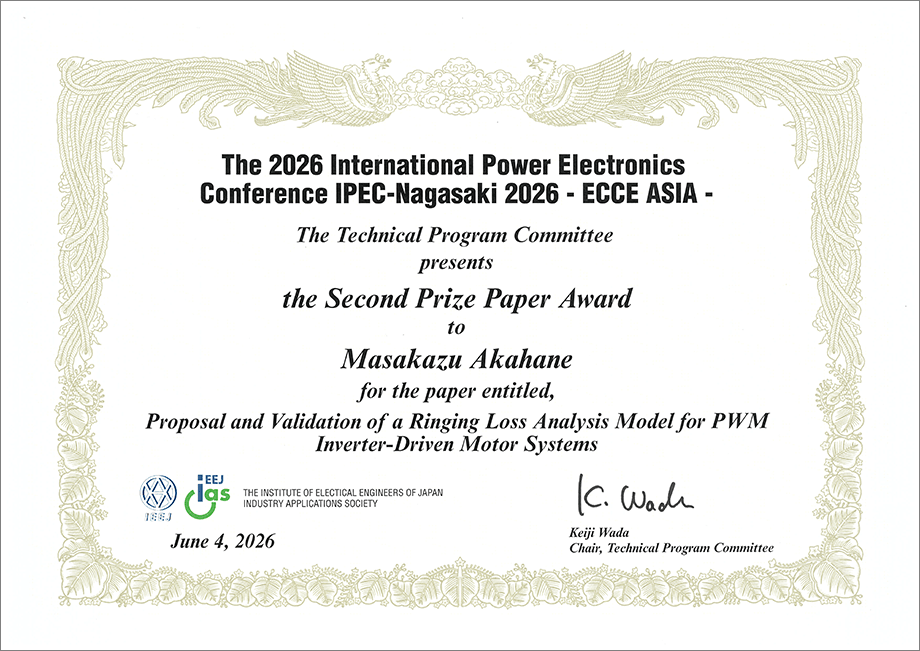
HIOKI E.E. Corporation is proud to announce that Masakazu Akahane, an engineer in the company's Sensing and Storage Unit, has received the Best Paper Award, Second Prize at the International Power Electronics Conference (IPEC-Nagasaki 2026 / ECCE Asia).
Co-authored with Professor Kan Akatsu of Yokohama National University, the paper - "Proposal and Validation of a Ringing Loss Analysis Model for PWM (Pulse-Width Modulation) Inverter-Driven Motor Systems"(*1) - proposes a new analytical model for a class of high-frequency energy losses that have historically been difficult to evaluate accurately, and have been insufficiently understood.
- *1:M. Akahane, K. Hayashi and K. Akatsu, "Proposal and Validation of a Ringing Loss Analysis Model for PWM Inverter-Driven Motor Systems," 2026 International Power Electronics Conference (IPEC-Nagasaki 2026 - ECCE Asia), Nagasaki, Japan, 2026, pp. 1-6, doi: 10.23919/IPEC-Nagasaki2026-EC64663.2026.11596686.
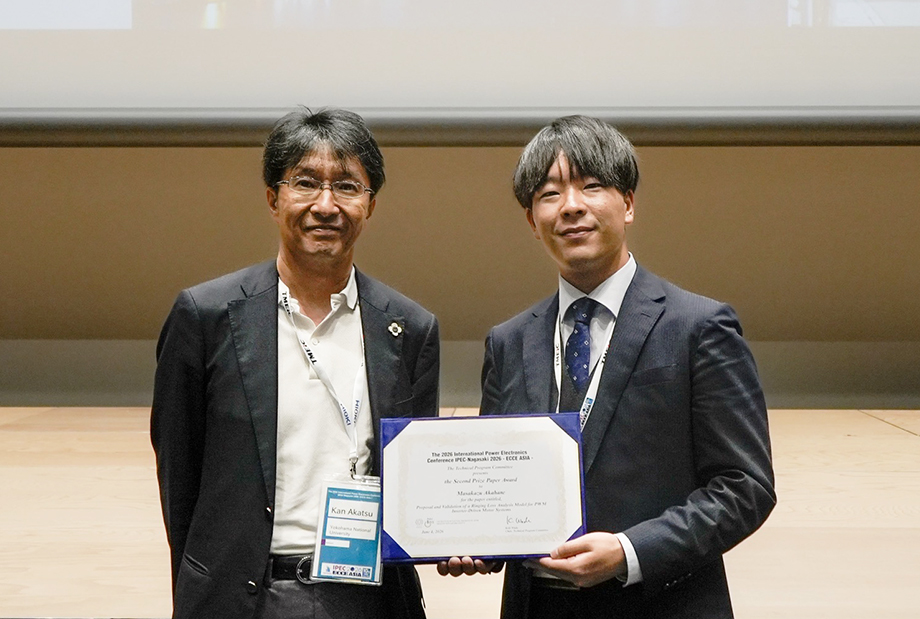 Professor Akatsu of Yokohama National University (left) and Masakazu Akahane of HIOKI's Sensing and Storage Unit (right)
Key developments and impacts
- Streamlining design processes: By predicting high-frequency losses during motor and inverter design, engineers can significantly reduce rework after prototyping, shortening development time and cutting costs. Validation through physical measurement confirmed the model's effectiveness, enabling ringing loss prediction at the design stage - a process previously considered difficult.
- Establishing measurement guidelines for high-accuracy efficiency and loss evaluation: Improving motor drive efficiency requires accurately capturing high-frequency, low-power-factor power components. The research technically validated the need for a power measurement system with wide bandwidth and high phase accuracy, and proposes measurement guidelines for next-generation inverter-motor development.
A New Approach to a Growing Challenge
With demand rising for higher efficiency in motor drive systems, like the ones in electric vehicles (EVs), industrial motor drives, and renewable energy systems, understanding the high-frequency energy losses associated with the switching operations of inverters using wide-bandgap (WBG) semiconductors such as Silicon Carbide (SiC) has become critical.
Next-generation semiconductors have enabled PWM (pulse-width modulation) inverters to run at higher switching speeds and voltages. But so-called "ringing losses" - high-frequency energy losses caused by voltage and current oscillations during switching events - increase correspondingly, presenting engineers with losses that are difficult to quantify and poorly understood at a system level.
These losses arise in part from unintended electrical properties such as hidden capacitances and inductance in the cables and motor windings connecting the inverter to the motor: properties that arise from how wires are wound and routed, and which are difficult to model accurately.
Akahane's paper clarifies the mechanism behind ringing loss and proposes a new analytical model to predict it. The paper shows that ringing loss rises proportionally with the motor's parasitic capacitance, the inverter's switching frequency, and the square of the DC bus voltage, giving engineers clear parameters to work with in next-generation motor drive design.
Model Validation Through HIOKI's Solutions
To confirm the model, the research team required instruments capable of capturing minute losses in the high-frequency range - a measurement challenge that conventional power analyzers could not meet.
Akahane's team used HIOKI's own power measurement solution: the PW8001 Power Analyzer with the U7005 Input Unit and CT6904A Current Sensor. Close agreement between simulation results and empirical data confirmed the model's validity and demonstrated the unique capability of HIOKI's wideband solution to measure in frequency ranges where conventional instruments fell short. The resulting model lets engineers predict ringing loss at the design stage, reducing the need for costly physical testing.
The abstract is publicly available at the link here:
Proposal and Validation of a Ringing Loss Analysis Model for PWM Inverter-Driven Motor Systems | IEEE Conference Publication | IEEE Xplore
About the International Power Electronics Conference (IPEC)
The International Power Electronics Conference (IPEC) is one of the world’s leading conferences in the field of power electronics, including power conversion technologies and motor drives. Organized by the Institute of Electrical Engineers of Japan (IEEJ), with the IEEE Power Electronics Society and the IEEE Industry Applications Society as co-sponsors, it brings together researchers, engineers, and academic professionals from around the world to present and discuss the latest technologies.
Amid the rapidly accelerating trends toward energy transition and electrification, IPEC plays an important role as a venue where cutting-edge technologies across a wide range of fields—including electric vehicles (EVs), renewable energy, and industrial motor drives—are brought together.
The 10th IPEC was held in Nagasaki from May 31 to June 4, 2026.
Contact Us
For inquiries regarding the content of this press release, please use Hioki's contact form.
- The information provided is current as of the date of publishing
- Please note that prices, specifications, and other information contained in this text are subject to change without notice.
- The company names and product names used in this text are registered trademarks or trademarks of their respective companies.
About Hioki
Founded in 1935 and headquartered in Ueda, Nagano, Japan, Hioki E.E. Corporation is a global manufacturer of electrical measuring instruments serving customers in more than 80 countries. The company’s portfolio spans power analyzers, battery testers, data loggers, and precision measurement systems, with principal markets in automotive, electronics, energy, and industrial manufacturing. Hioki’s research and manufacturing operations are based in Nagano, Japan.